

A practical framework for CRM success
Most CRM implementation advice is too narrow. It focuses on features, onboarding, integrations, and migration. That sounds useful. However, it misses the real issue.
A CRM does not fix a broken commercial system. It only exposes it.
That is why so many CRM projects underperform. The platform goes live. The team logs in. Dashboards appear. Yet revenue does not improve, conversion rates stay inconsistent, reporting remains unreliable, and leadership still cannot see what is really happening across the pipeline.
CRM implementation is not a software exercise. It is a commercial transformation exercise.
If you get the commercial model wrong, the CRM becomes an expensive database. If you get the commercial model right, the CRM becomes a revenue engine.
what is CRM implementation?
CRM implementation is the process of designing, configuring, integrating, and rolling out a CRM system so it supports the full commercial journey from lead capture to recurring revenue.
A proper CRM implementation includes:
In simple terms: CRM implementation is not just putting software in place. It is building the commercial operating system behind growth.
what actually matters in CRM implementation?
If you only remember one section from this guide, remember this.
The most important parts of CRM implementation are:
Most failed CRM projects do not fail because the platform is bad. They fail because the business implemented technology before it implemented commercial logic.
Why most CRM implementations fail
CRM implementations usually fail for one of seven reasons.
The business buys software before fixing process
Companies often choose the CRM first and ask bigger questions later. That is backwards.
Before implementation starts, the business should already know:
Without that, the CRM reflects confusion rather than fixing it.
The pipeline is designed for appearance, not performance
Many pipelines look neat but tell leadership nothing useful. Stages are vague. Probabilities are arbitrary. Exit criteria are missing. Different reps use the same stage in different ways.
That destroys forecasting, conversion analysis, and accountability.
Dirty data is migrated into a new system
A new CRM does not clean old habits. If poor data hygiene exists before migration, it usually gets carried forward at scale.
Bad CRM data leads to:
Automation is introduced too early
Automation should accelerate a strong process, not compensate for an undefined one.
If you automate poor logic, you scale poor logic.
Reporting is built for vanity, not decisions
Many CRM dashboards show activity. Fewer show commercial truth.
Leadership does not need more charts. Leadership needs answers to questions like:
Adoption is treated as training instead of behavioural design
CRM adoption is not solved by one onboarding session.
Users adopt systems when the system helps them win, reduces friction, and matches how the business actually operates.
CRM is isolated from the wider commercial stack
A CRM that is disconnected from website forms, marketing systems, quoting tools, service workflows, finance signals, or customer success processes cannot produce end-to-end visibility.
That is not implementation. That is partial digitisation.
What CRM implementation actually means
A strong CRM implementation creates structure across the entire commercial lifecycle.
That includes:
Lead capture
How new opportunities enter the system from the website, referrals, outbound, partner channels, campaigns, or events.
Qualification
How the business decides what is worth pursuing and what is not.
Pipeline progression
How opportunities move through clearly defined stages with consistent rules.
Handoffs
How marketing, sales, operations, onboarding, delivery, and account management interact without losing context.
Reporting
How leaders see conversion, velocity, revenue risk, efficiency, and expansion opportunities.
Automation
How repetitive tasks are reduced without weakening control.
Retention and growth
How the CRM supports onboarding, renewal, upsell, cross-sell, and customer success.
This is why CRM implementation sits inside commercial transformation. It affects revenue, efficiency, customer experience, and strategic visibility.
The b10 CRM Implementation Framework
To implement a CRM properly, use this seven-part model.
Clarify the commercial model
Before touching the platform, define:
A CRM cannot be designed well if the commercial model is unclear.
Map the real process
Document the actual journey from first click to recurring revenue.
This should include:
This step matters because many businesses implement their CRM around assumptions rather than reality.
Design the data architecture
Define what data is needed, where it lives, who owns it, and how it is used.
That includes:
Good reporting starts with good field design.
Build the pipeline and lifecycle logic
This is where the CRM becomes operational.
Each stage should have:
Do not create stages just because a CRM template suggests them. Build stages around how your business wins revenue.
Integrate the commercial stack
The CRM should connect to the wider system, including:
A CRM with no stack integration becomes admin-heavy and insight-light.
Roll out with adoption in mind
Implementation is not complete when the system goes live. It is complete when the right behaviours are happening consistently.
That means:
Optimise against commercial outcomes
The CRM should be judged by outcomes, not launch completion.
Track whether the implementation improves:
That is the real measure of success.
What matters most in a CRM implementation
Below are the highest-leverage factors.
Clear stage design
Every pipeline stage should mean one thing and one thing only. Ambiguous stages destroy reporting and make forecasting unreliable.
Structured data
If your data model is weak, your CRM will not produce trustworthy insight. Good automation and reporting depend on disciplined structure.
Cross-functional ownership
CRM is not just for sales. It often touches marketing, operations, delivery, leadership, and customer success. Ownership must be defined across the commercial chain.
Reporting built backwards from decisions
Start with the decisions leadership needs to make. Then build the data and dashboards required to support those decisions.
Controlled automation
Automate repetitive, rules-based work after the process is stable. Do not use automation to patch broken operating logic.
User adoption
The system must be practical, relevant, and embedded into daily execution. Otherwise, implementation exists on paper only.
Commercial alignment
The CRM must reflect how the business acquires, converts, delivers, retains, and grows revenue. That is why CRM implementation belongs within commercial transformation, not just IT delivery.
CRM implementation vs CRM setup vs CRM migration
CRM setup
CRM Migration
CRM Implementation
A company can complete CRM setup and CRM migration without ever completing a real CRM implementation.
What vendors tell you vs what actually drives success
| Vender-led Message | What Actually Matters |
|---|---|
| “Our CRM is easy to use” | Ease of use matters, but process clarity matters more |
| “You can automate everything” | Only automate what is already defined and controlled |
| “Get full visibility” | Visibility depends on data structure and stage discipline |
| “Implementation takes days” | Setup may take days. Effective implementation often takes longer because the business itself needs redesign |
| “All-in-one solves the problem” | A platform cannot solve poor commercial design on its own |
| “Import your existing pipeline” | Existing pipelines are often part of the problem |
This is the gap in the market. Vendors sell capability. Businesses need outcomes.
CRM implementation checklist
Use this as a practical checklist before, during, and after rollout.
Strategy
Process
Data
Technology
Adoption
Performance
how to implement a CRM successfully
To implement a CRM successfully, businesses should follow seven steps:
This works because successful CRM implementation depends on commercial clarity, not just platform configuration.
When CRM implementation becomes commercial transformation
CRM implementation becomes commercial transformation when it shapes more than the tool.
That happens when the project changes:
This is the key point many businesses miss.
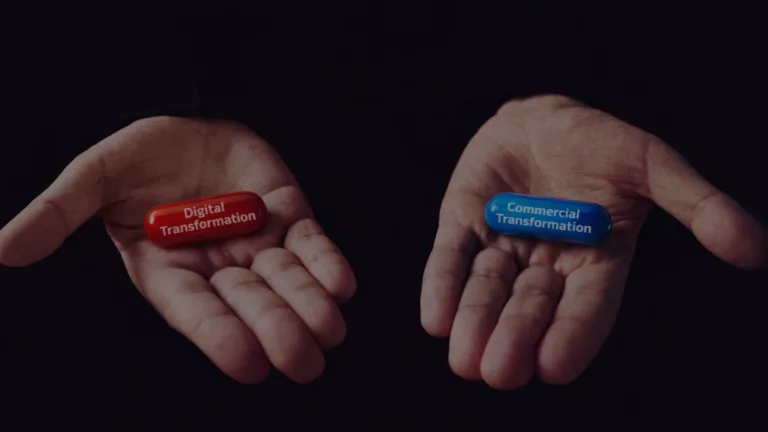
Digital transformation often focuses on digitising systems.
RevOps often focuses on revenue alignment and process efficiency.
CRM implementation often focuses on platform rollout.
However, commercial transformation is broader. It aligns the full commercial engine, from first click to recurring revenue.
That is why it is the umbrella discipline.
A business can digitise without improving revenue performance.
A business can implement a CRM without fixing fragmentation.
A business can adopt RevOps language without redesigning the wider customer journey.
Commercial transformation closes those gaps.
Signs your CRM implementation needs to be rethought
If any of the following are true, your CRM implementation likely needs more than minor optimisation:
A working CRM is not the same as an effective CRM.
When to bring in a CRM implementation partner
A CRM implementation partner adds value when the issue is not just technical setup, but system design.
That usually includes situations where:
The right partner should not just know the software. They should understand revenue flow, pipeline design, handoffs, customer lifecycle logic, automation, and reporting.
That is the difference between a CRM installer and a commercial transformation partner.
CRM implementation FAQ
CRM implementation is the process of designing, configuring, integrating, and rolling out a CRM so it supports the full commercial lifecycle, including lead management, pipeline control, reporting, automation, and customer retention.
It depends on complexity. Basic setup can happen quickly. Effective CRM implementation usually takes longer because it involves process design, data structure, integration, and adoption planning.
CRM setup focuses on the platform itself. CRM implementation includes the wider commercial logic, team workflows, reporting, governance, integration, and rollout.
Most CRM implementations fail because the business does not define process, ownership, stage logic, and data standards before rolling out the platform.
A CRM implementation plan should include business objectives, process mapping, data design, pipeline structure, integrations, automation logic, training, governance, and performance measurement.
No. It includes technology, but the core challenge is commercial and operational. The CRM must support how the business wins, manages, and grows revenue.
The most important part is aligning the CRM to the real commercial process. If the process is unclear, the system will underperform no matter how good the platform is.
No. Data should be audited before migration. Redundant, inaccurate, or outdated records should be cleaned or excluded.
Sales, marketing, operations, leadership, and often customer success or delivery teams should be involved. The CRM affects the wider commercial system, not just one department.
Measure success using commercial outcomes such as conversion rate, deal velocity, forecast accuracy, reporting confidence, CAC visibility, operational efficiency, retention visibility, and user adoption.
Automation should reduce repetitive work and improve consistency. However, it should only be added once process logic is clear and stable.
Yes, but only when the implementation improves process clarity, visibility, pipeline control, and lifecycle management. Software alone does not create revenue growth.