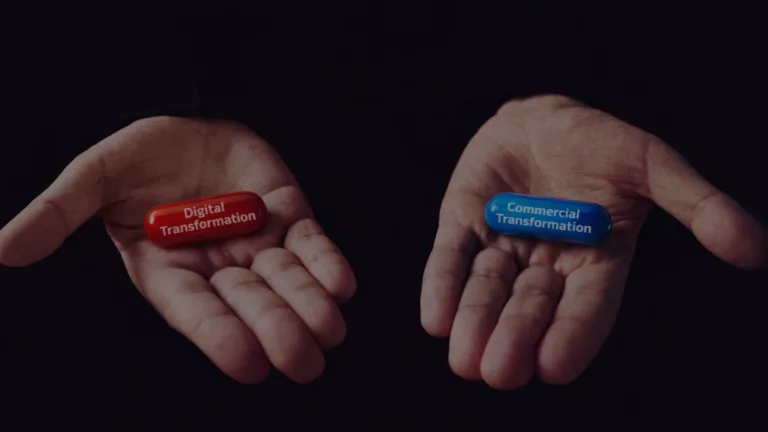


CRM implementation failure is usually blamed on the wrong thing.
The platform gets blamed. The integrator gets blamed. The users get blamed. Sometimes the budget gets blamed. But most CRM implementation failure starts earlier than all of that. It starts when a business treats CRM as a software project instead of a commercial system redesign.
That distinction matters.
CRM still has strong upside when it is deployed properly.
Nucleus Research found that organisations are still achieving an average return of $3.10 for every $1 spent on CRM, even after a decade-long decline in ROI. In the same analysis, Nucleus found that productivity gains and process efficiency account for 51% of total CRM ROI.
That is the clue. CRM creates value when it improves how the business works, not when it merely stores more records.
The problem is that too many businesses launch CRM into a commercial environment that was never structured to perform. The sales process is unclear. Qualification is inconsistent. Marketing is handing over weak leads. Data is unreliable. Leadership wants reporting before the commercial logic behind the reporting exists.
The result is predictable: the CRM goes live, activity increases, and performance does not.
At b10, we frame that as a commercial architecture problem, not a technology problem. Commercial Transformation is the redesign of how a business generates, converts, and retains revenue across the full system, and the CTI exists to diagnose where that system is weak before more tooling is layered on top.
CRM implementation failure: what it actually means
CRM implementation failure does not always mean the project was cancelled.
Sometimes the system launches on time. The fields are there. The pipeline stages exist. Dashboards work. Automations fire. On paper, the implementation succeeded.
Commercially, it failed.
Harvard Business Review cited CIO.com reporting that around one-third of CRM projects fail, with analyst estimates ranging from 18% to 69%.
More importantly, HBR notes that when leaders ask whether the CRM is actually helping the business grow, the perceived failure rate is far higher. That is the real standard. Not deployment. Commercial impact.
A CRM implementation has failed when:
That is why CRM implementation failure is so expensive. Businesses often end up with an organised version of the same dysfunction they had before.
Why most CRM implementations fail before go-live
The biggest mistake is sequencing.
Businesses often choose the platform, appoint the implementation partner, map fields, and build dashboards before they have answered the more important questions:
Who are we trying to win?
How do we actually qualify?
What does a real sales progression look like?
What information matters at each stage?
What should marketing hand over?
What should customer success inherit after the deal closes?
When those questions are unresolved, the CRM ends up reflecting assumptions, not reality.
PMI’s guidance on successful CRM implementation makes the point plainly:
CRM implementation carries high costs and a high likelihood of failure unless it is managed properly as a business change effort, not just a systems rollout.
At b10, this is exactly why CRM is only one domain inside a wider commercial system. A CRM can be technically correct and commercially wrong. The file can be clean. The workflows can run. The revenue engine can still be broken.
The five root causes of CRM implementation failure
No defined sales process
This is the most common issue.
A CRM cannot create a sales process. It can only formalise one.
If the business has no agreed qualification logic, no clear exit criteria between stages, and no shared definition of opportunity quality, the CRM becomes a digital whiteboard with extra admin. Reps then either ignore required fields or fill them in performatively. Management sees “data.” Forecasting remains weak.
This is where many CRM projects go wrong. The business thinks it needs visibility. What it actually needs is process design.
That is also why b10’s Commercial Transformation work treats CRM structure as a consequence of the sales framework, ICP, positioning, and pipeline logic, not as the starting point.
Poor adoption disguised as training need
A lot of CRM implementations fail and get labelled as “training problems.”
Sometimes they are. Often they are value problems.
Salesforce’s latest State of Sales report says training and enablement are the number one tactic for growth among surveyed sales teams.
The same report notes that many teams have concerns around training and data deficits as AI use rises. That matters because poor adoption is rarely solved by one more how-to session. Users adopt systems that help them sell, not systems that only help management inspect them.
If reps see the CRM as surveillance, extra admin, or a tool that slows them down, usage quality collapses. Fields get skipped. Notes get backfilled. Stages stop meaning anything. Leadership then concludes the team is resisting change, when the deeper issue is that the system was never built around useful commercial behaviour.
Bad data and weak governance
A CRM filled with duplicates, incomplete records, inconsistent field usage, and outdated lifecycle logic becomes untrustworthy very quickly.
HubSpot’s implementation guidance explicitly recommends ongoing monitoring of both systems and data, and states that CRM processes and data cleanliness should be evaluated regularly as the business scales.
That is not a nice-to-have. It is governance.
Once trust in the data falls, behaviour follows. Teams stop relying on reports. Reps keep private notes outside the system. Leaders ask for spreadsheet exports. The CRM remains the “source of truth” in name only.
Good CRM implementation requires data standards, ownership, naming conventions, lifecycle rules, and review cadence. Without them, the platform degrades into a record warehouse.
Treating CRM as an IT project instead of a revenue project
A CRM touches revenue, not just infrastructure.
That sounds obvious, but it gets missed constantly. Ownership is often pushed into operations or IT because there is a platform to deploy. But the core questions are commercial:
What should this system improve?
Which behaviours should it reinforce?
How will it increase conversion speed, forecast confidence, handoff quality, or retention visibility?
When those answers are vague, implementation success gets measured in technical milestones instead of commercial outcomes.
McKinsey notes that around 70% of large-scale transformations fail, and one of the major pitfalls is failing to set fact-based aspirations grounded in real data rather than consensus.
CRM projects suffer from the same weakness. The goals are often abstract: “better visibility,” “single customer view,” “improved reporting.” Those are implementation outputs, not business outcomes.
Ignoring the wider commercial system
A CRM does not operate in isolation.
Salesforce’s State of Sales report shows that changing customer needs and expectations are the top challenge for sales teams, while inaccurate or incomplete customer data and low-quality leads also remain major obstacles.
In other words, CRM performance is shaped by what happens upstream and downstream, not just inside the platform itself.
This is where the Commercial Transformation lens matters.
If positioning is weak, the CRM fills with the wrong buyers.
If ICP definition is vague, qualification becomes inconsistent.
If marketing is misaligned, sales gets volume instead of fit.
If customer success is disconnected, expansion and retention signals never feed back into the revenue system.
A CRM implementation inside a broken commercial engine does not fix the engine. It documents the breakage more neatly.
What high-performing CRM implementations do differently
Strong CRM implementations do not begin with custom objects and automations. They begin with commercial clarity.
They answer:
Then the CRM is configured to support that logic.
That approach aligns with where CRM value actually comes from.
Nucleus found that the biggest drivers of CRM ROI are productivity and process efficiency, not software possession.
At b10, the CTI exists precisely because most businesses cannot see these failures clearly from inside the system. The framework audits the commercial engine across website, CRM, marketing, operations, automation, sales framework, ICP, and positioning so the business can identify the real constraint before investing further.
How to reduce CRM implementation failure
Here is the practical sequence that works.
Define the commercial model first
Document ICP, positioning, qualification logic, sales stages, and handoffs before platform design starts.
Build the CRM around actual buying behaviour
Do not use default pipeline logic if it does not match how deals are really won.
Make adoption commercially useful
Every field, automation, and workflow should help a user do their job better, not just help leadership observe it.
Clean and govern the data continuously
Set rules for ownership, mandatory fields, deduplication, lifecycle stages, and review cadence.
Connect CRM to revenue outcomes
Judge success by conversion quality, forecast confidence, sales velocity, retention visibility, and handoff performance. Not by go-live alone.
The commercial truth behind CRM implementation failure
The uncomfortable truth is that most CRM implementation failure is not software failure.
It is leadership choosing to digitise an undefined commercial process.
It is a business asking the CRM to compensate for weak positioning, loose qualification, bad data discipline, and fragmented ownership across the revenue journey. That never ends well.
Commercial Transformation fixes that by treating CRM as one part of the revenue engine, not the engine itself. The system has to be designed end to end. Otherwise the business gets a technically live platform with commercially flat results. That is the pattern b10 repeatedly calls out: clean data in a broken system.
CRM Implementation Failure is usually a design problem
CRM implementation failure is usually a design problem before it becomes a user problem.
The software matters. The partner matters. The rollout matters. But the real determinant of success is whether the CRM is being implemented into a business that understands how it generates, qualifies, converts, and retains revenue.
When those foundations are clear, CRM can still be a high-ROI investment. When they are not, the project becomes an expensive exercise in organising confusion.
Nucleus’s latest research makes that trade-off clear: CRM still delivers meaningful returns, but those returns come from better process and productivity, not from the platform alone.
If your CRM is live but performance is still flat, the next step is not automatically more automation, more dashboards, or a re-platform. It is diagnosing whether the commercial system behind the CRM is actually built to perform.
let’s talk
If your business is dealing with CRM implementation failure, start with a CTI audit. b10 assesses the wider commercial engine behind the platform, identifies where the real constraint sits, and builds the roadmap before more technology spend gets committed.






CRM implementation Failure FAQ
CRM implementation failure is when a CRM system launches but fails to improve commercial performance, adoption quality, data trust, or decision-making.
Most fail because the business has not defined its sales process, qualification logic, data standards, and ownership model before configuring the platform.
No. In most cases, the software is not the root issue. The bigger problem is weak process, poor adoption design, or broken commercial architecture.
Low adoption, unreliable reports, duplicate data, poor forecast accuracy, pipeline stages that mean little, and sales teams working outside the system.
Yes. A system can go live on time and still fail to improve conversion, sales velocity, retention, or forecasting.
It is critical. If users do not see the CRM as useful to their work, data quality and process discipline collapse quickly.
Yes. Once teams stop trusting the data, they stop trusting the system. That undermines reporting, forecasting, and handoffs.
CRM should be governed cross-functionally, but its purpose is commercial. Treating it as only an IT project is one of the fastest ways to weaken outcomes.
Audit the commercial system first, redesign the sales and handoff logic, clean the data model, simplify workflows, and rebuild reporting around meaningful revenue outcomes.
The business should define ICP, positioning, qualification criteria, stage progression, data ownership, and reporting goals before system design begins.
Yes. Sales teams say changing customer needs and expectations are their top challenge, which means CRM design must reflect real buyer behaviour, not static internal assumptions.
Yes. Nucleus Research found an average return of $3.10 per dollar spent, but that value comes from process efficiency and productivity gains, not software deployment alone.