

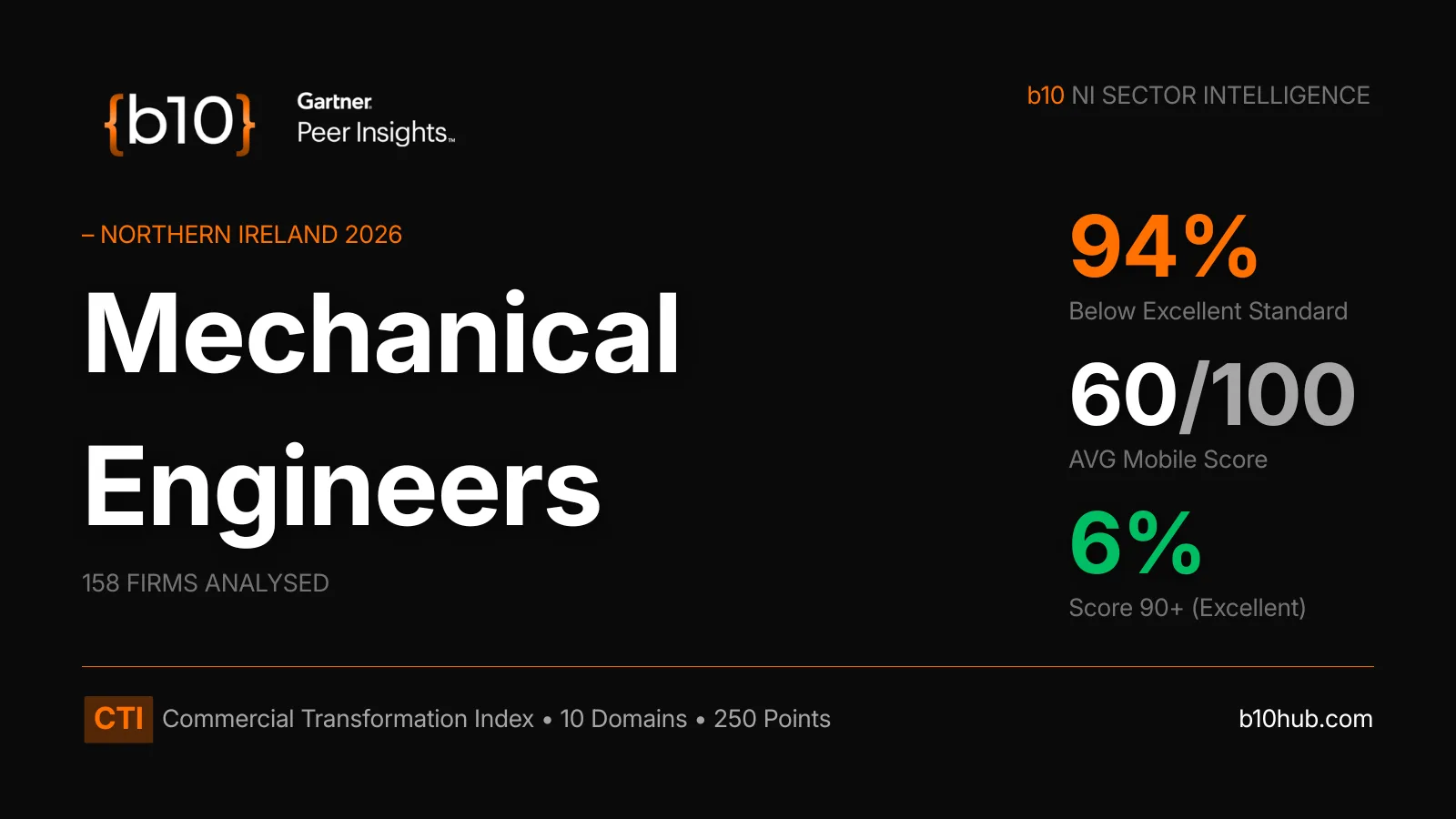
b10 analysed the performance of 158 mechanical engineering firms across Northern Ireland. Every website, every mobile score, every missed opportunity. The average mobile PageSpeed score is 60 out of 100. Google classifies that as “needs improvement.” 94% of these businesses are failing mobile performance standards and it is costing them clients they never knew they lost.
Why Mobile Performance Is a Commercial Problem
Google’s Core Web Vitals and PageSpeed score are not abstract technical metrics. They are direct proxies for conversion, discoverability, and competitive position. A site scoring below 50 on mobile is almost certainly ranking lower in search results, losing visitors before the page loads, and projecting a commercial image that undermines the quality of the work behind it.
For mechanical engineering firms in Northern Ireland, many of them high-quality, well-established operations, this is a silent revenue leak. The problem is invisible to the business owner, but very visible to their potential clients who land on a slow, poorly optimised site and quietly leave.
Commercial Intelligence
Performance Benchmarks by band
| Band | Score Range | Sites | % Of Cohort | Commercial Implication |
|---|---|---|---|---|
| Excellent | 90-100 | 10 | 6% | Mobile-ready, search-favoured, trust-building |
| Needs Work | 50-89 | 109 | 69% | Visible friction, ranking suppressed, leakage likely |
| Poor | 0-49 | 39 | 25% | Significant visitor abandonment, near-invisible on mobile search |
about this analysis
This Analysis Is Built on the CTI
This analysis is part of b10‘s Commercial Transformation Index (CTI) which is a proprietary 10-domain, 250-point scoring framework that measures commercial readiness across every dimension that drives revenue.
The CTI was built because vanity metrics such as follower counts, award wins, brand awareness, don’t tell you whether a business is commercially fit. The CTI does. It scores organisations across ten interconnected domains, identifying exactly where performance is strong, where it is leaking, and what to fix first.
Website performance, including mobile PageSpeed, sits within the Digital Infrastructure domain of the CTI. A poor mobile score doesn’t just mean a slow website. It means a commercial system with a visible gap at the very first point of contact.
The Website Analysis we created uses automated Insights scoring to deliver sector-level intelligence across Northern Ireland’s business community — publishing aggregate findings openly and making firm-level data available for outreach and improvement planning.
Recommendations for Mechanical Engineering Firms in Northern Ireland
Based on the cohort data and CTI framework analysis, these are the highest-impact interventions for the 94% of firms currently underperforming on mobile.
Address these in order. The first three interventions deliver the highest return for the least time and cost. If your score sits below 50, start with images. If you’re between 50 and 75, render-blocking resources are likely your primary constraint. Structured data applies to every site regardless of score and it is the one fix that compounds over time.
Uncompressed images are the single most common cause of poor mobile scores in this cohort. Converting to WebP/AVIF and implementing lazy loading typically delivers a 15–25 point score improvement.
High Impact
JavaScript and CSS files loaded synchronously in the page head delay First Contentful Paint. Deferring non-critical scripts removes a major bottleneck for mobile users on slower connections.
High Impact
LCP, CLS, and FID are Google’s direct ranking signals. Sites scoring in the “Poor” band typically fail on all three. Address LCP first — it has the most direct impact on perceived load speed.
High Impact
Many engineering sites in this cohort were built for desktop and adapted for mobile. A structural mobile-first redesign — not a responsive patch — is often the correct fix for scores below 40.
Medium Impact
Time to First Byte (TTFB) above 600ms indicates a server or hosting problem, not a code problem. Upgrading to managed hosting with edge caching resolves this and improves all downstream metrics.
Medium Impact
Only a small minority of sites in this cohort have Schema markup. For engineering firms, LocalBusiness, Service, and Review schema unlocks rich SERP features including star ratings, FAQs, and service listings.
SEO Multiplier
What This Means for Northern Ireland’s Engineering Sector
Northern Ireland’s mechanical engineering community is technically excellent. The work is world-class. But the commercial infrastructure supporting that work such as the websites, the digital presence, the first impression — is not keeping pace. A sector with genuine competitive strengths on the global stage is being represented online at a standard that doesn’t reflect those strengths.
The good news is that this is a fixable problem. Unlike shifting market conditions or talent shortages, website performance is entirely within a firm’s control. The firms in the top 6% aren’t fundamentally different businesses. They’ve simply invested in making their first commercial touchpoint match their technical capability.
b10‘s Commercial Transformation Index gives any business in this sector a clear, data-driven diagnosis of where their commercial model stands — website performance included — and a prioritised roadmap for closing the gap.
Frequently Asked Questions
Google classifies scores of 90–100 as Excellent, 50–89 as Needs Improvement, and 0–49 as Poor. In this cohort of 158 mechanical engineering firms, only 10 — 6% — achieve an Excellent score. The sector average is 60. If your site scores below 80 on mobile, you have a measurable, fixable improvement opportunity that is directly affecting your search visibility and the first impression you make on every prospect who finds you.
Google’s Core Web Vitals — Largest Contentful Paint, Cumulative Layout Shift, and Interaction to Next Paint — are direct ranking signals. A site scoring below 50 on mobile is being actively suppressed in search results before content quality, authority, or relevance is even considered. For local and sector-specific searches, where competition is often limited to a small number of firms, this suppression can be the difference between appearing on page one and not appearing at all.
b10 compiled a list of mechanical engineering firms across Northern Ireland using business directory data and ran every accessible website through the b10 CTI. Scores reflect mobile performance only, captured at a single point in time. All data is based on publicly accessible websites.
No and this is important context. Mobile PageSpeed is one measurable, automated data point. b10’s Commercial Transformation Index assesses websites across a broader set of criteria including conversion architecture, SEO fundamentals, CRM integration, and lead capture effectiveness. A site can score 90 on PageSpeed and still be commercially underperforming. The score tells you whether the technical foundation is sound. The CTI tells you whether the commercial system built on top of it is working.
The CTI is b10’s proprietary 10-domain, 250-point commercial readiness framework. It assesses every component of a B2B commercial model such as Website, CRM, Marketing, Operations, Automation, Sales Framework, ICP, Positioning, Pricing Strategy, and Retention and Customer Success. The CTI then produces a scored, prioritised output that shows exactly where a business is strong, where it is leaking revenue, and what to fix first. It was built because financial metrics tell you the outcome. The CTI tells you why.
b10 runs the CTI assessment on behalf of the business — it is not a self-service tool. We gather the relevant information, score each domain against the framework criteria, and deliver a findings report with a prioritised improvement roadmap. For businesses that engage b10 beyond the assessment, the CTI becomes the delivery blueprint. We implement the fixes, not just identify them. This is how we work with clients like Catalyst Innovation Centre, where b10 was selected over Accenture, and SAP, to redesign their commercial operations infrastructure.
It depends on where the CTI identifies the gaps. Most engagements involve a combination of commercial strategy, CRM implementation, website and digital infrastructure, automation build, and sales framework development. We work across all of it — not as separate workstreams handed to separate agencies, but as a single connected commercial system. Typical engagements run between 8 and 20 weeks for initial implementation, with ongoing managed service options where appropriate.
The fastest wins such as PageSpeed improvements, CRM configuration, automation of manual processes, are measurable within weeks. Commercial outcomes including pipeline growth, conversion rate improvement, and reduced sales cycle length typically become visible within one to two quarters. The full CTI score is reassessed at 90 days to track movement across all ten domains.
Traditional consulting firms diagnose and report. Digital agencies execute within their lane — usually website or paid media — without touching the wider commercial model. b10 does neither exclusively. We sit at the intersection of commercial strategy and operational delivery, which means we can identify a problem in positioning and fix the CRM workflow that reinforces it in the same engagement. b10 holds a 5-star Gartner Peer Insights rating with zero dislikes. Every current client has come through inbound, because the work speaks for itself.
The initial CTI assessment, where b10 reviews your business and produces a scored findings report, is complimentary for qualifying businesses. There is no cost and no commitment. If the findings identify gaps b10 can close, we will tell you what that looks like. If not, you leave with a clear picture of where your commercial model stands and what to prioritise. Submit your details in the form below and b10 will be in touch within one working day.