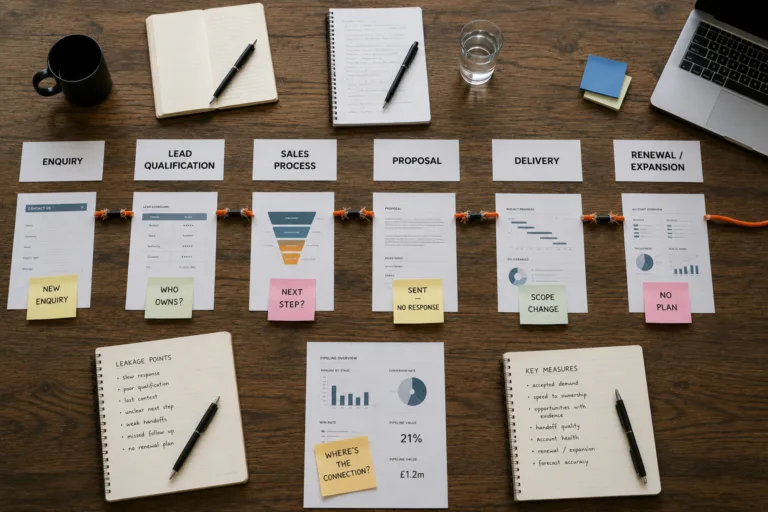




The Complete Guide for B2B Leaders
Commercial transformation is a category we helped define, and at B10, it’s the only thing we do. As the UK’s leading commercial transformation consultancy, rated 5 stars on Gartner Peer Insights, we’ve built a practice around one belief: that the gap between a B2B business’s current revenue performance and its actual potential is almost always a commercial engine problem. This guide breaks down exactly what commercial transformation is, what it involves, and what it takes to do it properly.
What is Commercial Transformation
Commercial transformation is the end-to-end redesign, implementation, and optimisation of every system that drives revenue in a B2B business from the website and CRM to marketing, sales, and operations, creating a single, unified commercial engine from first click to recurring revenue.
It’s not a rebrand. It’s not a new CRM subscription. And it’s absolutely not a strategy deck that gets filed away after the kickoff meeting.
Commercial transformation is the deliberate, structured overhaul of the machinery that drives revenue from the moment a prospect first encounters your brand online, to the point they become a loyal, recurring customer. Every touchpoint. Every system. Every process.
At its core, a commercial transformation answers one fundamental question: why is this business not growing as fast as it should be, and what needs to change structurally to fix that?
The answer almost always touches five interconnected domains:
When these five elements are aligned, integrated, and optimised, the result is what we call a commercial engine. A system that reliably generates, converts, and retains revenue, with minimal manual intervention and maximum visibility at every stage.
Commercial Transformation vs. Digital Transformation
What’s the Difference?
This is one of the most common questions we hear. The two terms overlap but are fundamentally different in scope and intent.
| Digital Transformation | Commercial Transformation | |
|---|---|---|
| Focus | Technology adoption across the business | Revenue performance across the commercial system |
| Goal | Modernise operations and infrastructure | Grow and optimise revenue generation |
| Scope | Whole business | Website → CRM → Marketing → Sales → Operations (the commercial engine) |
| Outcome | More efficient organisation | A faster, more predictable commercial engine |
| Who leads it | CTO / IT Director | CEO / CCO / Revenue Leader |
| Typical mistake | Buying tech without changing process | Getting a strategy report without implementation |
Digital transformation asks: how do we use technology better?
Commercial transformation asks: how do we use everything we have such as technology, people, process, and data, to grow revenue faster, more predictably, and more profitably?
The two are complementary, but commercial transformation is explicitly revenue-first.
the 5 pillars of a commercial engine
Understanding what commercial transformation is requires understanding what a commercial engine is made of. Here are the five pillars and what a transformed, high-performing version of each looks like.
Pillar 1: Website — Your 24/7 Sales Asset
Your website is not a brochure. In a transformed commercial system, it is an active, conversion-optimised, SEO-driven asset that works around the clock to attract, educate, and convert your ideal customers.
A transformed website:
Pillar 2: CRM is The Operational Spine
A CRM in a transformed commercial engine is not a database. It is the single source of truth for every customer and prospect relationship, deeply integrated with every other pillar.
A transformed CRM:
Pillar 3: Marketing for Demand Generation at Scale
Marketing in a transformed commercial engine is not about impressions and engagement. It is about generating qualified pipeline, consistently, at a measurable cost.
Transformed marketing:
Pillar 4: Sales as A Repeatable, Measurable Framework
Most B2B businesses have people who sell. Few have an efficient sales system. Commercial transformation installs one.
A transformed sales function:
Pillar 5: Operations for Automation and Workflow Efficiency
The operational layer is what ties everything together. In a transformed commercial engine, workflows are automated, handoffs are seamless, and human effort is reserved for high-value activities.
Transformed operations:
Why Most B2B Businesses Need Commercial Transformation Right Now
The commercial landscape for B2B businesses has changed faster in the last four years than in the previous twenty. Buyers are more informed, more independent, and more demanding. Competition is fiercer. Attention is scarcer. And the margin for operational inefficiency is shrinking.
Here is what the data tells us:
The businesses winning market share right now aren’t necessarily the ones with the best product. They are the ones with the best commercial engine and they built it deliberately.






What Does Commercial Transformation Actually Look Like in Practice?
Let’s move from the abstract to the concrete. Here is what commercial transformation looks like in a real B2B business.
Before transformation:
After transformation:
The difference isn’t theoretical. It shows up in revenue, margins, team capacity, and the ability to scale.
The Commercial Transformation Process
How It Works at B10
This is where we part company with most consultancies.
A lot of firms will audit your commercial function and hand you a report. Maybe a deck. Possibly a 90-day roadmap. Then they leave, and you’re expected to implement it with the same team that created the problems in the first place.
That is not how we work.
At B10, commercial transformation is a hands-on, implementation-first engagement. We audit, we design, we build, we implement, and we manage and optimise ongoing. Here is what that process looks like:
Stage 1: The Commercial Transformation Audit
We begin with a structured, ten-domain audit of your entire commercial system such as your website, CRM, marketing, operations, automation, sales framework, ideal customer profile (ICP), positioning, pricing, and retention. Each domain is scored against a set of performance criteria, producing your Commercial Transformation Index (CTI), a clear, objective baseline of where you are today and what the gaps are costing you.
This is not a surface-level review. We go deep into your data, your processes, your tooling, and your team. And at the end of it, you have a precise picture of exactly what needs to change and in what order.
Stage 2: Commercial Engine Design
Based on the audit, we design your future commercial engine such as the architecture of how your website, CRM, marketing, sales, and operations will work together as a unified, integrated system. We specify the platforms, the workflows, the automations, the KPIs, and the integration points.
Every design decision is made with one filter: does this drive more revenue, more efficiently?
Stage 3: Implementation
Here is where most consultancies stop. We start.
Our team implements everything we design. We build and configure your CRM. We set up your marketing automation sequences. We create the workflows and integrations. We implement the sales framework and tooling. We optimise your website for conversion and search.
You don’t receive a recommendation. You receive a working system.
Stage 4: Management and Optimisation
Once your commercial engine is live, the work shifts to continuous improvement. We monitor performance across every pillar, optimise based on data, identify friction points before they become problems, and keep your system calibrated as your market and business evolve.
This is where the compounding returns of commercial transformation are realised. Not at go-live, but in the months and years that follow.
How Long Does Commercial Transformation Take?
This is one of the most common questions we receive and the honest answer is: it depends on where you are starting.
Here is a realistic framework:
| Stage | Typical Timeline |
|---|---|
| Commercial Transformation Index Audit | 2–3 weeks |
| Engine Design | 2–4 weeks |
| Core Implementation (CRM, Marketing, Sales Framework) | 6–12 weeks |
| Full System Integration and Optimisation | Ongoing |
| Measurable Revenue Impact | Typically 90–180 days from implementation start |
The businesses that see the fastest results are those that commit fully by providing access, making decisions quickly, and treating commercial transformation as the strategic priority it is, not a side project.
That said, we sequence implementation deliberately. High-impact, lower-complexity changes like CRM configuration, lead routing automation, and conversion rate optimisation are delivered early, so you begin seeing returns while the broader system is built.
What Are the Signs Your Business Needs Commercial Transformation?
You don’t need to wait for a revenue crisis to start. These are the early and not-so-early warning signs that your commercial engine needs attention:
Revenue Signals:
Process Signals:
Data Signals:
Structural Signals:
If three or more of these resonate, a commercial transformation is not a question of if, it’s a question of when, and how costly the delay will be.
Common Commercial Transformation Mistakes
and How to Avoid Them
Commercial transformation is a significant undertaking, and there are patterns of failure we see repeatedly. Here are the most costly, and how to avoid them.
Mistake 1
Starting with technology instead of strategy
Buying a new CRM or marketing platform before defining how it needs to work is one of the most expensive mistakes a B2B business can make. Technology enables strategy, it doesn’t replace it. Start with the commercial engine design. Then select and configure the tools.
Mistake 2
Transforming in isolation
Changing your CRM without changing your sales process, or launching marketing automation without aligning it to your sales funnel, produces fragmented results. Commercial transformation only works when all five pillars are addressed as an interconnected system.
Mistake 3
Treating it as a project, not a capability
Commercial transformation is not a one-time project with an end date. It is the development of a permanent organisational capability. The ability to understand, optimise, and scale your commercial engine on an ongoing basis. The businesses that treat it as such consistently outperform those that don’t.
Mistake 4
Hiring advisors who don’t implement
A strategy without implementation is a cost, not an investment. If your commercial transformation partner produces reports and recommendations but doesn’t get their hands dirty building what they prescribe, you are paying for analysis that someone else still has to act on, usually poorly, and always slowly.
Mistake 5
Underestimating the change management component
Commercial transformation changes how people work. Sales reps who’ve operated independently for years now have a structured framework. Marketing teams that measured success in vanity metrics now measure pipeline contribution. This requires clear leadership, consistent communication, and active management of the transition.
Why B10?
The Commercial Transformation Consultancy That Builds, Not Just Advises
B10 is a commercial transformation consultancy built around one conviction: the gap between strategy and outcomes is implementation.
We exist to close that gap.
We are not a research firm. We are not a strategy boutique. We are not an agency that runs campaigns and calls it transformation. We are a specialist consultancy that audits, designs, implements, manages, and continuously optimises complete commercial engines for B2B businesses.
Here is what that means in practice:
We audit with precision
Our Commercial Transformation Audit evaluates eight domains of your commercial system against objective performance criteria and produces a scored index so you know exactly what you’re working with, and exactly what needs to change.
We implement what we recommend
Every recommendation we make, we build. CRM configuration, marketing automation, sales frameworks, workflow integration, website optimisation. Our team does the work, not your already-stretched internal team.
We manage and optimise for the long term
Commercial transformation doesn’t end at go-live. We provide ongoing management and optimisation of your commercial engine, ensuring it improves month on month and scales with your ambitions.
We cover the entire commercial engine
Website. CRM. Marketing. Sales. Operations. First click to recurring revenue. End to end. No gaps, no handoffs to other agencies, no blind spots.
We’re also proud to be rated 5 stars on Gartner Peer Insights and ranked #1 over the last twelve months — recognition from the clients who’ve been through this process with us and come out the other side with a commercial engine that performs.
But the proof that matters most is not a rating. It’s the businesses we’ve built alongside, the ones now forecasting revenue with confidence, scaling without adding headcount, and growing in markets they previously couldn’t penetrate.
What People Are Asking About Commercial Transformation
Commercial transformation is the systematic redesign of a B2B business’s entire revenue generation system — including its website, CRM, marketing, sales, and operations — to create a unified, data-driven, and largely automated commercial engine that delivers predictable, scalable growth.
Sales transformation focuses specifically on improving the sales function — processes, frameworks, coaching, and tooling. Commercial transformation is broader: it includes sales, but also encompasses marketing, the website, CRM, and operations. It treats these as a single interconnected system rather than isolated functions.
A commercial transformation consultancy audits a business’s commercial function, designs an optimised commercial engine, implements the required systems and processes, and manages ongoing performance. B10 specifically covers website, CRM, marketing, sales, and operations — from audit through to continuous optimisation.
Costs vary based on the scope, complexity, and current state of your commercial system. B10 engagements typically include an audit phase, an implementation phase, and an ongoing management retainer. We design engagements around the specific needs of each business. Book a discovery call to understand what investment is appropriate for your situation.
No. Commercial transformation is relevant for any B2B business where revenue growth is a priority and where the current commercial system has material gaps. Many of our most impactful engagements have been with businesses of 10–100 people, where the commercial engine is under-built relative to the quality of the product or service.
The platforms we implement and optimise include HubSpot (CRM and marketing automation), Make.com (workflow automation and integration), and a range of specialist tools depending on each client’s sector and operational requirements. Platform selection is always driven by what the commercial engine needs — not by vendor preference.
Success is measured against specific, pre-agreed commercial metrics. Typically these include: pipeline growth, lead-to-customer conversion rate, customer acquisition cost, revenue attribution by channel, sales cycle length, and customer lifetime value. We establish baseline measurements at the audit stage so improvement is quantified, not assumed.
Commercial transformation is an ongoing capability, not a one-time project. B10 provides ongoing management and optimisation services — monitoring performance, refining automations, adapting the commercial engine to market changes, and identifying new opportunities for improvement. Our clients don’t just get a transformed engine; they get a partner who keeps it performing.