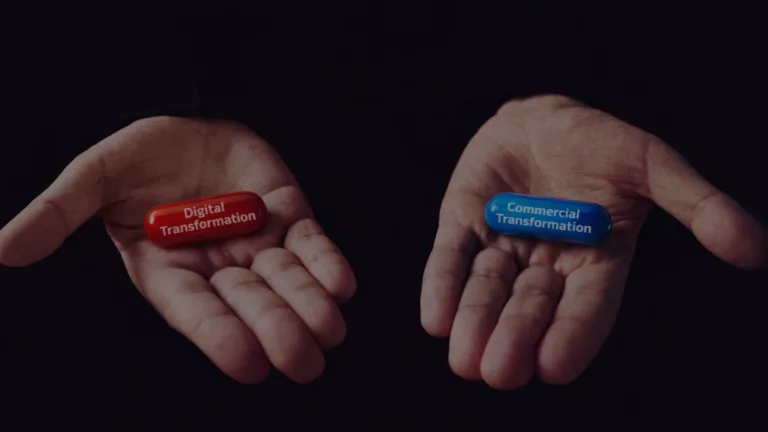


Most B2B leaders are investing in the wrong thing.
They’re hiring better salespeople, deploying CRM tools, running sales training programmes, and optimising pipelines. They call it Sales Transformation. On the surface, it looks like progress. But the buyer has already moved. This article on Sales Transformation vs Commercial Transformation dives into the differences and why it matters.
B2B buyers now spend just 17% of their total buying time in direct contact with potential vendors. By 2025, 61% of B2B buyers reported preferring a rep-free buying experience entirely.
If the commercial decision is being formed before the salesperson enters the room, what exactly is Sales Transformation solving?
This is the distinction that most B2B organisations are failing to make — and it’s costing them growth.
What Is Sales Transformation?
Sales Transformation is the process of improving the performance of a sales function. It typically means: sales training and skills development, CRM implementation and pipeline management, sales enablement tools, territory and quota design, recruitment, onboarding, and incentive structure redesign.
It’s legitimate work. It has value. But it starts and ends inside one function — and that’s the problem.
Sales Transformation treats revenue as a sales problem. It assumes the bottleneck lives in the sales team: reps aren’t skilled enough, processes aren’t structured enough, tools aren’t good enough. In some cases, that’s true. In most B2B businesses, the bottleneck isn’t the sales team. It’s everything that happens before the conversation.
Only 11% of sales organisations are able to drive commercial success while executing a transformation. The other 89% either stall or regress.
That’s not a talent problem. That’s a systems problem.
What Is Commercial Transformation?
Commercial Transformation is the structural redesign of the entire revenue engine — every system, process, and function that contributes to how a business generates, converts, and retains revenue. Where Sales Transformation is a function-level fix, Commercial Transformation is an enterprise-level reframe.
At b10, we define Commercial Transformation across ten interconnected commercial domains:
These domains are measured using the Commercial Transformation Index (CTI) — a 250-point diagnostic scoring businesses across all ten areas to reveal exactly where commercial performance is breaking down and, critically, where to prioritise first.
Run your CTI assessment: Scored across all 10 commercial domains, with sector benchmarks.
The Critical Difference
A Comparison
| Dimension | Sales Transformation | Commercial Transformation |
|---|---|---|
| Scope | Sales function only | Entire revenue engine |
| Focus | People and Process | Systems and Infrastructure |
| Measurement | Pipeline, quota attainment | Revenue architecture maturity |
| Root cause addressed | Symptom | Structural |
Commercial Transformation doesn’t replace Sales Transformation — it contains it. Sales is one of ten domains. It just shouldn’t be the only one.
Why the Distinction Matters Now
The B2B buying environment has structurally changed. Consider what the data is consistently showing:
B2B buyers now complete approximately 80% of their buying journey without direct vendor contact. Forrester and McKinsey data puts the self-directed research portion consistently at 70%+.
Of B2B buyers actively avoid suppliers who send irrelevant outreach. Bad prospecting doesn’t just fail — it actively damages relationships with potential customers before a conversation begins.
Misalignment between commercial functions — marketing, sales, and customer success operating without shared infrastructure — costs B2B companies 10%+ of annual revenue according to Forrester analysis. And McKinsey’s research has consistently shown that 70% of transformation initiatives fail to meet their objectives. Bain’s 2024 analysis found that 88% of business transformations fail to achieve their original ambitions.
The common thread in every failure: treating the symptom rather than the system.
The Sales-Led Trap
Three Failure Patterns
There’s a cognitive trap many B2B leaders fall into. When revenue slows, the first response is to look at sales. Revenue is “a sales number,” so it must be a sales problem. This produces three predictable failure patterns:
The Revolving Door Hire
New sales leadership is brought in every 18–24 months. Each cohort inherits broken commercial infrastructure and under-delivers. The infrastructure is never examined. The hire gets replaced. The infrastructure remains.
The CRM Obsession
A new CRM is implemented. Contact data is cleaned. Pipeline stages are redefined. But the leads being put into the CRM are wrong, the messaging attached to them is wrong, and the conversion pathway is broken. Clean data in a broken system is still a broken system.
The Sales Training Cycle
Reps go through training programmes on discovery, objection handling, and closing. Win rates improve marginally. But the underlying positioning is still commoditised, pricing is still reactive, and churn is still eating the revenue growth.
Each pattern shares the same root cause: the sales function is being optimised in isolation from the rest of the commercial architecture.
What Commercial Transformation Actually Looks Like in Practice
When we run the CTI with B2B businesses, the gaps are almost never in the sales team. They typically sit in:
Fix those five domains, and the sales team’s effectiveness multiplies — without a single hour of sales training.
See how your business scores across all 10 commercial domains. The CTI identifies your commercial maturity across each domain with sector benchmarks and actionable prioritisation.
The Commercial Transformation Maturity Model
Commercial maturity isn’t binary. Businesses move through identifiable stages. The CTI scores businesses from 0 to 250 across six maturity bands:
Most B2B companies sit between Developing and Emerging. They are not failing — they are running on commercial infrastructure that was never designed to scale.
Who Owns Commercial Transformation?
This is where the distinction becomes most critical at a leadership level.
Sales Transformation is typically owned by the Sales Director or CRO. It lives within a function, with a natural owner and a defined budget.
Commercial Transformation must be owned by the CEO, MD, or Commercial Director. It is a strategic programme, not a departmental initiative. It requires authority across every function — and the willingness to accept that the problem is systemic rather than personnel-based.
This ownership gap is precisely why Sales Transformation dominates as a category. It has a natural sponsor. Commercial Transformation requires the most senior commercial leader in the business to take ownership of the whole machine.
How to Know If You Need Commercial Transformation
Ask these six questions:
- Do you know, with precision, which types of companies buy fastest, pay most, and stay longest?
- Is your CRM a source of commercial intelligence — or a place where data goes to die?
- Does your positioning clearly articulate why you, for that specific buyer, versus every alternative?
- Are your pricing conversations based on value — or on pressure?
- Do you have an active, structured customer success programme driving retention and expansion?
- Can you forecast next quarter’s revenue with confidence?
If the answer to more than two of those questions is “no” or “not really” — this is a Commercial Transformation problem, not a sales training one.
The Naming Problem Has a Cost
Sales Transformation dominates the market because it’s familiar, fundable, and has an obvious sponsor. But the name describes only one part of the problem. And businesses that fix only one part of the problem will keep encountering the same revenue ceilings — new salespeople, same results.
Commercial Transformation is the accurate description of what B2B companies actually need. It’s structural, cross-functional, measurable, and comprehensive.
Sales Transformation optimises the engine. Commercial Transformation fixes the road. You can have the most optimised engine in the world — if the road is broken, you’ll never reach full speed.
The distinction matters. Because what you name the problem determines what you try to fix.
Sales Transformation vs Commercial Transformation FAQs
Sales Transformation improves the performance of a single sales function through training, tools, and process. Commercial Transformation restructures the entire revenue engine across all commercial domains — positioning, ICP, CRM, marketing, automation, pricing, customer success, and sales framework — treating revenue as a systems problem rather than a sales problem.
According to Gartner’s December 2024 survey of 234 senior sales leaders, only 11% of sales organisations successfully drive commercial success while executing a transformation. The primary reason is that Sales Transformation addresses one function while the underlying commercial infrastructure — positioning, ICP clarity, pricing, and retention — remains broken.
Commercial Transformation is the structural redesign of a business’s entire revenue engine, spanning ten commercial domains: website and digital presence, CRM architecture, marketing, operations, automation, sales framework, ICP clarity, positioning, pricing strategy, and customer success. It is measured by the Commercial Transformation Index (CTI), a 250-point diagnostic. You can read more about Commercial Transformation Here
The CTI is a 250-point diagnostic framework across 10 commercial domains: Website, CRM, Marketing, Operations, Automation, Sales Framework, ICP, Positioning, Pricing Strategy, and Retention & Customer Success. Each domain is assessed not just for whether the component exists, but whether it is commercially configured and performing — and how it connects to the other nine domains.
For example: the CRM domain does not simply ask whether a CRM is in place. It assesses whether the CRM is built around a defined sales framework, whether pipeline stages reflect real commercial milestones, whether the data it captures is being used to improve conversion, and whether it is integrated with the marketing and retention layers. The CTI produces a scored baseline across all 10 domains — a precise picture of where the commercial engine performs and where it suppresses revenue — and a prioritised commercial architecture blueprint. It is the starting point for every B10 engagement.
Commercial Transformation must be owned by the CEO, MD, or Commercial Director. Unlike Sales Transformation — which has a natural owner in the Sales Director or CRO — Commercial Transformation requires cross-functional authority and must be a strategic programme, not a departmental initiative.
ICP stands for Ideal Customer Profile — the specific, validated definition of the type of customer a business converts at the highest rate, retains longest, and generates the most expansion revenue from. Most B2B businesses have a general sense of who they sell to. Very few have a rigorously validated ICP built from closed-won data, retention patterns, and expansion revenue analysis.
Without a validated ICP, every upstream commercial investment is directionally uncertain. Marketing generates volume towards an undefined target. The CRM pipeline includes deals that should never have been qualified. The website tries to speak to everyone. Commercial transformation validates the ICP as a foundational input — and then aligns website, marketing, CRM, positioning, and sales framework around it. An unvalidated ICP is one of the most common root causes of high CAC, low conversion rates, and poor retention. It is Domain 07 in the CTI for a reason.
No. Sales transformation is a subset of commercial transformation, covering the sales function in isolation. Commercial transformation covers all 10 domains — website, CRM, marketing, operations, automation, sales framework, ICP, positioning, pricing strategy, and retention. Each domain is interdependent. The sales framework can only perform as well as the ICP it is working from, the positioning it is expressing, the marketing pipeline feeding it, and the CRM it is operating inside. Addressing the sales function in isolation without the surrounding commercial architecture is equivalent to optimising one stage of a broken production line. Output may improve at that stage. System performance does not.