Access b10 through structured procurement routes for commercial transformation, CRM, digital systems, automation, technology and operational improvement.
Pipeline hygiene is the discipline of keeping your sales pipeline accurate, current and commercially useful. It covers deal stages, close dates, next steps, ownership, contact data, qualification, activity history and forecast logic. Poor pipeline hygiene is not just CRM admin. It weakens sales visibility, damages forecast confidence, slows follow-up and hides revenue leakage across the commercial system.
Most B2B companies do not wake up one morning and decide they have a pipeline hygiene problem. They usually say something else first.
“The CRM is a mess.” “The forecast keeps changing.” “The sales team says the pipeline is strong, but revenue does not land.” “Marketing says leads are being handed over. Sales says the leads are poor.” “We need more leads.”
Sometimes that last sentence is true. Often it is not. More leads into a messy pipeline only creates more noise. If deal records are stale, stages do not reflect reality, close dates roll forward every month, next steps are missing and sales activity is disconnected from the CRM, leadership cannot see the truth. The business then makes decisions from a distorted commercial picture.
That is why pipeline hygiene matters. It is not a housekeeping task. It is a commercial control issue.
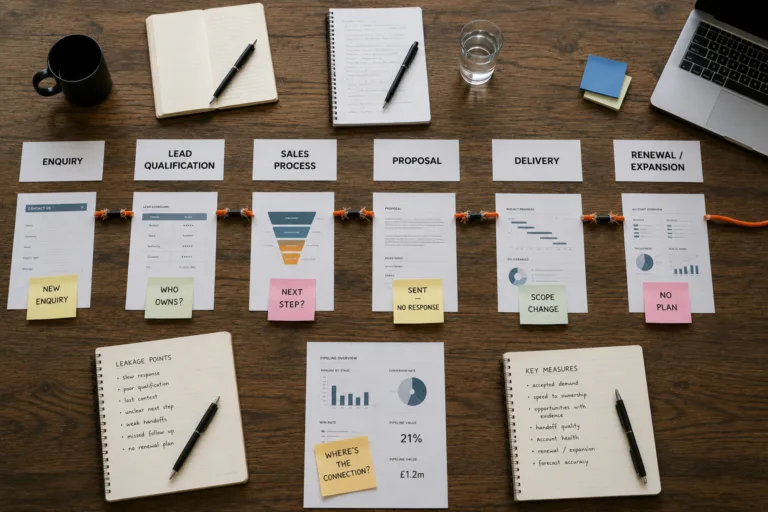
At b10, we view pipeline hygiene as one part of Commercial Transformation: the structured diagnosis, rebuild and operation of the systems that turn first click into recurring revenue. A clean pipeline does not exist in isolation. It depends on clear positioning, strong qualification, accurate CRM structure, disciplined sales process, marketing-to-sales handoff, automation, reporting and ownership. When those pieces do not work together, the pipeline becomes fiction.
What is pipeline hygiene?
Pipeline hygiene is the ongoing process of keeping your sales pipeline accurate, complete, current and aligned with how your business actually sells. It ensures that every opportunity in your CRM reflects a real deal, a real buyer, a real stage, a real next action and a realistic commercial value.
In practical terms, good sales pipeline hygiene means:
deal stages reflect buyer progress, not rep optimism;
close dates are realistic and reviewed regularly;
deal amounts are accurate and not inflated to protect the forecast;
next steps are clear, dated and owned;
stale opportunities are progressed, re-qualified or closed out;
contacts, companies and stakeholders are connected correctly;
source, campaign and attribution data are captured cleanly;
forecast categories are governed rather than guessed;
automation reinforces the process instead of masking poor behaviour;
leaders can trust pipeline reporting enough to make decisions.
The simple version: pipeline hygiene keeps your CRM close to commercial truth.
The hard version: it forces the business to confront whether its sales process, qualification standards, CRM design and operating rhythm are strong enough to scale.
Why poor pipeline hygiene damages revenue
Messy pipeline data creates more than reporting frustration. It damages the full revenue engine.
If a deal sits in “proposal sent” for six weeks with no next step, the CRM may still show pipeline value. Commercially, the opportunity may already be dead. If a sales rep keeps rolling the close date into next month, the forecast may look healthy while cash flow quietly deteriorates. If marketing leads enter the CRM without source consistency, you cannot tell which campaigns create real commercial intent. If lifecycle stages are inconsistent, handoffs break. If sales and operations cannot see what has actually been promised, onboarding suffers.
Sales transformation: the sales process becomes consistent, measurable and coachable.
Revenue transformation: forecast accuracy, pipeline quality and conversion improve because decisions use cleaner data.
GTM transformation: marketing, sales and customer handoffs connect around the same commercial truth.
Digital transformation: the CRM, automation and reporting stack supports commercial outcomes, not just tool adoption.
A company can buy HubSpot, Salesforce, Pipedrive, Capsule, Close or Monday CRM and still have poor pipeline hygiene. The platform is not the strategy. The platform only shows the quality of the commercial system underneath it.
The visible symptoms of poor pipeline hygiene
Pipeline hygiene problems usually show up through symptoms that leadership already recognises. They often feel operational, but they are commercial.
Forecasts cannot be trusted
The forecast changes late in the month because the pipeline was never clean enough to show what would actually close.
Deals sit still for too long
Opportunities remain open with no activity, no decision date, no stakeholder movement and no clear next step.
CRM usage feels like admin
Salespeople update records because they are asked to, not because the CRM helps them sell.
Marketing and sales disagree
Marketing sees lead volume. Sales sees poor qualification. Leadership sees no clean source-to-revenue story.
Pipeline value looks inflated
The board, founder or MD sees a large pipeline number, but too much of it is stale, low-fit or poorly qualified.
Follow-up is inconsistent
Some prospects are handled well. Others go cold because ownership, tasks and next steps are not governed.
These symptoms are rarely solved by “telling the team to update the CRM”. That may create temporary compliance, but it does not fix the system. The real question is why the pipeline became unreliable in the first place.
The deeper causes
why pipeline hygiene breaks down
Poor pipeline hygiene is usually a process design problem before it is a people problem. Sales teams are often blamed for not updating the CRM, but the CRM may not reflect how the business actually sells. Stages may be vague. Required fields may be meaningless. Automation may create noise. Managers may review quantity rather than quality. Marketing may pass leads before they are properly qualified. Operations may not feed back what happens after close.
The common causes are:
Deal stages describe internal activity instead of buyer progress
Stages like “contacted”, “follow-up”, “proposal” and “negotiation” can be useful, but only if they represent clear buying signals. If a stage is based on what the salesperson has done rather than what the buyer has confirmed, the pipeline becomes optimistic rather than accurate.
Qualification is weak or inconsistent
If opportunities are created too early, the pipeline becomes bloated. A contact who downloaded a guide is not automatically an opportunity. A friendly conversation is not automatically a deal. Without qualification rules, teams confuse interest with intent.
Close dates become placeholders
When close dates are guessed, copied forward or set to the end of the month by default, forecast accuracy collapses. A close date should reflect a real buying process, not a reporting habit.
Next steps are not governed
A live opportunity should have a next step. Not a vague note. Not “follow up soon”. A real next step includes an action, owner and date. Without that, the deal is not being actively managed.
CRM fields exist without commercial purpose
Many CRMs collect fields that nobody uses. Others miss fields that actually matter. Pipeline hygiene improves when every important field connects to a decision, workflow, report or customer journey action.
Reporting rewards volume instead of truth
If leaders only ask “how much pipeline do we have?”, teams learn to preserve pipeline. If leaders ask “how much qualified, active, next-step-owned pipeline do we have?”, behaviour changes.
Automation is added before the process is clean
Automation can enforce pipeline hygiene, but it cannot rescue a broken process. Automating poor deal stages, weak qualification or bad ownership rules only spreads the problem faster.
Pipeline hygiene is a Commercial Transformation problem
If the website attracts poor-fit enquiries, the pipeline gets polluted. If positioning is unclear, prospects enter without understanding value. If qualification is weak, low-intent leads become opportunities. If the CRM is poorly configured, teams cannot track the right signals. If sales process is inconsistent, deal stages stop meaning anything. If operations are disconnected, closed-won does not smoothly become onboarding, delivery and retention.
Before you clean the CRM, diagnose the commercial reality. A cleanup without diagnosis is usually temporary. The pipeline looks better for a month, then the same problems return.
Use this diagnostic sequence.
Check whether your pipeline stages match buyer reality
For each stage, ask: what must the buyer have done or confirmed to justify this stage? If the answer is unclear, the stage is weak. Strong stages are objective enough that two different people would move the same deal to the same place.
Example: “Proposal sent” is not enough. Better logic may include: need confirmed, decision criteria understood, budget route identified, proposal sent to named decision-maker, follow-up meeting booked.
Separate leads, opportunities and real pipeline
A lead is not a deal. A meeting is not a deal. A proposal request is not always a deal. Define the threshold for creating an opportunity. This protects forecast quality and prevents the CRM becoming a dumping ground for every conversation.
Audit close dates by stage and evidence
Look for deals closing this month with no recent activity, no decision-maker engagement, no proposal, no next meeting or no procurement step. Those deals may be forecast noise.
Review stale deals by age and movement
Every stage needs an expected movement window. A deal that sits too long without progress should trigger action: re-engage, re-qualify, move back, close lost, or mark as nurture.
Check required fields against real decisions
Do not make fields required because someone wants more data. Make fields required because they support routing, prioritisation, reporting, automation, forecasting or customer handoff. If nobody uses a field, question why it exists.
Inspect source-to-pipeline visibility
Can you see where qualified pipeline comes from? Not just leads. Qualified pipeline. Without this, marketing spend, content strategy and sales capacity planning are guesswork.
Test sales-to-operations handoff
Closed-won is not the finish line. If the deal record does not carry the information operations, onboarding or customer success needs, pipeline hygiene problems become delivery problems.
Review CRM automation against behaviour
Automation should reduce manual burden and enforce standards. It should not create tasks nobody uses, fields nobody trusts or alerts everyone ignores.
Pipeline Hygiene Made Simple
Automation Is Available for HubSpot Users
Pipeline hygiene should not rely on sales managers manually chasing every missing update, stale deal, overdue next step or drifting close date. Once the pipeline rules are clear, much of the hygiene process can be automated.
Through b10’s partner network, eligible clients using HubSpot can access a specialist pipeline hygiene automation solution that helps identify and rectify common CRM hygiene issues before they damage reporting, forecasting or sales follow-up.
This option is designed for teams that already use HubSpot but struggle to keep the pipeline clean in day-to-day sales activity. It can help flag issues such as missing next steps, stale deals, incomplete records, poor stage discipline, close-date drift and other pipeline risks that usually force sales leaders into manual chasing.
The key point is sequence.
Automation works best after the commercial process has been diagnosed. If the pipeline stages are unclear, qualification rules are weak or the CRM does not reflect how the business actually sells, automation may simply accelerate confusion. b10 starts by identifying the commercial hygiene rules that matter, then helps clients decide whether automation should be used to enforce them.
For HubSpot users, this creates a practical route from pipeline diagnosis to ongoing pipeline discipline. The business gets clearer rules, better visibility and less manual follow-up. Sales teams get prompts where action is needed. Leaders get a cleaner view of active pipeline, stuck deals and forecast risk.
Pipeline hygiene does not need to become another admin burden. With the right diagnostic work first, and the right automation layer in place, it can become part of the operating rhythm behind a cleaner, more controlled commercial system.
The pipeline hygiene maturity model
Every company sits somewhere on a maturity curve. Knowing your level helps you decide whether the next move is cleanup, redesign, automation, reporting or wider Commercial Transformation.
Level 1: Reactive cleanup
The CRM is cleaned only when reporting breaks, leadership loses confidence, or a forecast call exposes the problem. Data quality depends on individual effort.
Level 2: Manual discipline
Sales managers review deals regularly, but hygiene still depends on reminders, spreadsheets and manual checking. Forecasts improve but remain fragile.
Level 3: Governed pipeline
Stages, fields, qualification rules, next steps and close-date logic are defined. Pipeline reviews focus on deal quality, not just deal volume.
Level 4: Automated enforcement
CRM workflows flag stale deals, missing fields, close-date drift, broken handoffs and incomplete activity. Automation supports behaviour without overwhelming the team.
The target is not perfection. The target is trusted enough data to make better decisions faster.
How to improve pipeline hygiene without creating sales admin overload
The fastest way to lose sales team adoption is to turn pipeline hygiene into a field-filling exercise. Salespeople should not feel like they are maintaining the CRM for management’s benefit only. The CRM should help them prioritise, follow up, progress deals and close work.
Use these principles:
Reduce fields before adding fields
Most CRMs carry legacy fields from previous processes, past campaigns and forgotten reporting needs. Remove or hide fields that do not support action. Then make the remaining fields matter.
Make every required field earn its place
A required field should support qualification, routing, forecasting, reporting, automation or handoff. If it does not, it becomes friction.
Use automation to prompt, not punish
Good automation nudges the right behaviour at the right time. Bad automation creates noise. Use alerts for missing next steps, stale stages, closing-soon deals without activity and handoff gaps.
Build pipeline reviews around decision quality
Do not ask reps to talk through every deal. Focus on movement, risk, blockers, next action, buyer evidence and disqualification. The point is commercial truth.
Close lost properly
Closed lost reasons are not admin. They are market intelligence. If reasons are vague, you cannot see whether the issue is price, timing, fit, competitor pressure, weak value, poor follow-up or no decision.
Connect hygiene to outcomes
Show the team how clean pipeline data improves prioritisation, coaching, forecasting, win rates, handoffs and fewer pointless internal questions. If the only visible benefit is management reporting, adoption will be weak.
Pipeline hygiene checklist for B2B companies
Use this as a practical working checklist before your next pipeline review.
Every open deal has a named owner.
Every open deal has a real next step with a date.
Every deal stage has objective entry criteria.
Every close date is supported by buyer evidence.
Deals with no activity are reviewed, re-qualified or closed out.
Deal values are current and not inflated.
Decision-makers, influencers and blockers are identified.
Lead source and campaign source are captured consistently.
Closed lost reasons are specific enough to support learning.
Marketing, sales and operations use the same definitions.
Dashboards separate raw pipeline from qualified active pipeline.
Automations flag stale deals, missing data and handoff risks.
Pipeline hygiene is reviewed weekly, not only at month-end.
What to measure when improving pipeline hygiene
Do not measure everything. Measure the signals that reveal whether pipeline quality is improving.
Stale deal percentage: how much pipeline has had no meaningful activity within the expected time window?
Next-step coverage: what percentage of open deals have a clear next action, owner and date?
Close-date drift: how often are close dates pushed forward without clear buyer movement?
Stage ageing: where do deals sit too long compared with expected movement?
Qualified pipeline ratio: how much of total pipeline meets your qualification standard?
Forecast variance: how far does forecasted revenue differ from actual closed revenue?
Source-to-pipeline quality: which channels create qualified pipeline rather than raw leads?
Closed lost clarity: how many lost deals have useful, specific reasons recorded?
These metrics do not just clean the CRM. They help leadership understand where the commercial system needs work.
the connection most businesses miss
Pipeline hygiene and lead generation
Pipeline hygiene can directly affect lead generation performance because it changes what the business learns from demand.
If CRM data is poor, the business cannot identify which channels attract good-fit opportunities. It cannot see which campaigns create real pipeline. It cannot separate enquiry volume from commercial intent. It cannot understand whether lead generation is failing because of traffic, offer, positioning, qualification, follow-up or sales process.
That creates wasted spend. The business keeps investing in lead generation without knowing whether the real constraint sits before, during or after the lead handoff.
This is where b10’s Commercial Transformation view matters. Lead generation does not end when a form is submitted. It continues through CRM capture, qualification, nurture, follow-up, sales process, proposal, close, onboarding and retention. Pipeline hygiene is the evidence layer that shows whether demand is turning into revenue efficiently.
When pipeline hygiene becomes a bigger transformation project
Sometimes the fix is straightforward. Clean the stages, enforce next steps, rebuild dashboards and install a weekly review rhythm.
Other times, poor pipeline hygiene reveals a larger commercial problem. That is usually the case when:
salespeople use different qualification standards;
proposals are inconsistent or slow;
handoff to operations is manual or unclear;
leaders cannot see source-to-revenue performance;
the founder or MD remains the only person who understands what is really happening.
At that point, the business does not just need CRM cleanup. It needs Commercial Transformation: diagnosis, redesign, implementation and ongoing operation across the system behind revenue.
How B10 helps fix pipeline hygiene
b10 helps founder-led and MD-led B2B companies diagnose and fix the commercial systems that stop revenue from scaling efficiently. Pipeline hygiene is a natural entry point because it exposes where the system is leaking control.
We assess pipeline structure, CRM data quality, sales process, qualification, follow-up, reporting, attribution and handoff risk. Where appropriate, this connects into CTI, b10’s commercial maturity diagnostic.
Rebuild
We redesign the pipeline around real buyer progress, clean CRM properties, clearer qualification standards, usable reporting and practical management workflows.
Automate
We add automation only after the process is clear. That may include stale deal alerts, next-step reminders, missing-data prompts, close-date checks, lifecycle updates, handoff workflows and HubSpot-specific hygiene tools through b10’s partner ecosystem.
Operate
We help turn pipeline hygiene into a repeatable operating rhythm. That means dashboards, review cadence, accountability, optimisation and ongoing commercial improvement.
The outcome is not a cleaner CRM for its own sake. The outcome is a commercial system that gives leadership better visibility, gives sales better focus, gives marketing better feedback and gives the business more control over revenue movement.
Pipeline hygiene FAQs
What is pipeline hygiene?
Pipeline hygiene is the process of keeping sales opportunities accurate, current and commercially useful inside your CRM. It includes deal stages, close dates, next steps, owners, activity, qualification, source data and forecast logic.
Why is pipeline hygiene important?
Pipeline hygiene matters because leadership needs accurate pipeline data to forecast revenue, coach sales teams, prioritise opportunities, measure lead quality and identify where deals are getting stuck.
What is the difference between pipeline hygiene and CRM data hygiene?
CRM data hygiene covers the wider quality of CRM records, including contacts, companies, fields, duplicates and lifecycle data. Pipeline hygiene focuses specifically on opportunities, deal movement, sales stages, forecast quality and active revenue management.
How often should pipeline hygiene be reviewed?
Pipeline hygiene should be reviewed weekly for active sales teams. Stale deals, close-date changes, missing next steps and forecast risks should not wait until month-end.
What causes poor pipeline hygiene?
Poor pipeline hygiene is usually caused by unclear deal stages, weak qualification, manual data entry, poor CRM adoption, inconsistent management rhythm, overcomplicated fields and automation added before the sales process is properly defined.
How do you clean a sales pipeline?
Start by removing stale or unqualified deals, correcting close dates, confirming next steps, standardising deal stages, checking deal values, cleaning source data and rebuilding dashboards around qualified active pipeline rather than raw pipeline value.
How does pipeline hygiene improve forecasting?
Pipeline hygiene improves forecasting by ensuring deal values, close dates, stages and probabilities reflect reality. This reduces inflated pipeline, late-stage surprises and decisions based on stale opportunities.
Is pipeline hygiene a sales problem or a RevOps problem?
It is both. Sales owns opportunity movement and deal truth. RevOps, commercial operations or leadership usually owns the system, governance, reporting and automation that make good hygiene sustainable.
When should a business get help with pipeline hygiene?
A business should get help when leadership cannot trust the forecast, sales follow-up is inconsistent, deal stages are unclear, the CRM is underused, pipeline value feels inflated or the business cannot see which activity turns into revenue.
What is a CTI audit?
A CTI audit is b10’s commercial diagnostic process used to assess where a business is underperforming across its wider commercial system.
your pipeline is either a control system or a comfort blanket
A clean pipeline tells the truth. A messy pipeline tells leadership what it wants to hear until the numbers fail to land.
If your CRM shows a large pipeline but revenue still feels unpredictable, the issue may not be demand. It may not be the sales team. It may not even be the CRM platform. The issue may be that the commercial system behind growth has never been properly diagnosed, rebuilt and operated.
Pipeline hygiene is one of the fastest ways to expose that truth.
START WITH DIAGNOSIS
Want to know where your pipeline is leaking revenue?
b10 helps B2B companies diagnose, rebuild and operate the commercial systems behind revenue growth. If your CRM, pipeline, sales process or HubSpot setup is difficult to trust, start with a CTI Diagnostic.