



An AI transformation strategy is not a list of AI tools. It is the operating plan for using artificial intelligence across data, workflows, CRM, sales, service, marketing, operations and decision-making to create measurable business value. For B2B companies, the commercial question is simple: will AI improve the journey from first click to recurring revenue, or will it add another layer of complexity to an already fragmented commercial system?
The announcement matters beyond Switzerland because it reflects a larger shift. AI is moving from novelty to infrastructure. It is moving into CRM, support workflows, customer operations, sales teams, customer experience, data cycles, partner ecosystems and productivity models. That should get the attention of CEOs, MDs, founders, commercial directors, sales directors and operations leaders.
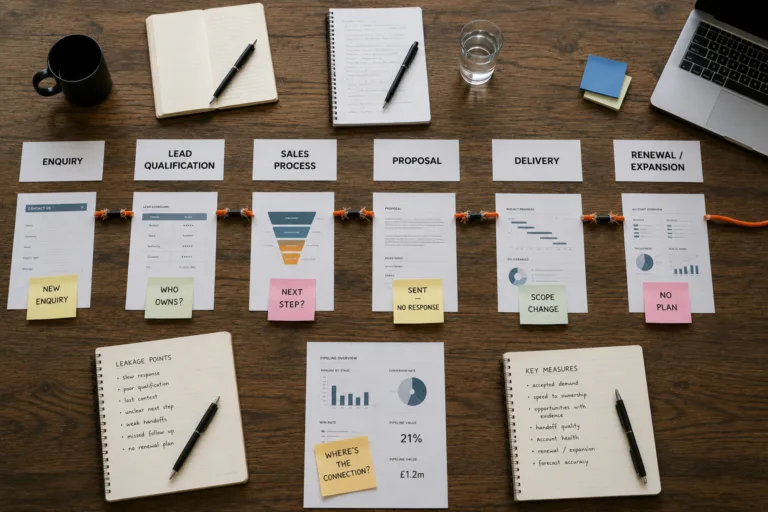
But it should also create caution. AI does not fix an underdeveloped commercial system by magic. If the CRM is messy, AI has messy context. If follow-up is inconsistent, AI can accelerate inconsistency. If the sales process is unclear, AI can produce more activity without better conversion. If reporting is weak, AI can make false confidence easier. If customer handoffs are manual and unowned, AI can automate fragments while the system still leaks revenue.
That is why the conversation should not start with “which AI tool should we buy?” It should start with “where is the commercial system mature enough for AI to create value, and where will AI expose the weakness?”
What is an AI transformation strategy?
In a B2B commercial context, an AI transformation strategy should answer six questions:
The Salesforce signal.
AI is becoming commercial infrastructure.
Those examples are important because they show the real direction of AI adoption. AI is not only writing copy or summarising calls. It is entering customer-facing operations, sales enablement, service delivery, customer routing, account support and workflow orchestration.
That is commercial infrastructure.
For founder-led and MD-led B2B companies, the lesson is not that every business should copy Salesforce, buy Agentforce or launch a large AI programme. The lesson is that the commercial engine is becoming more intelligent, more automated and more dependent on connected data. The companies that benefit will be the ones that understand the system AI is entering.
AI transformation vs digital transformation vs commercial transformation.
Digital Transformation.
Primary focus.
Typical failure mode.
b10 view.
AI Transformation.
Primary focus.
Typical failure mode.
b10 view.
Commercial Transformation.
Primary focus.
Typical failure mode.
b10 view.
b10’s view is direct: AI transformation in B2B companies should be judged by its effect on commercial performance.
Does it improve conversion?
Does it reduce leakage?
Does it improve CRM discipline?
Does it make follow-up faster and more consistent?
Does it improve sales visibility?
Does it reduce manual handoffs?
Does it strengthen retention and account growth?
Does it help the business scale revenue with more control?
The commercial problem: AI scales what already exists
Consider a business with a poor website journey, inconsistent lead capture, unclear qualification criteria, a CRM that does not reflect the sales process, weak follow-up discipline and limited reporting. Adding AI on top may help the team write faster emails, summarise calls and generate content. But the fundamental leakage remains. Demand still enters the system badly. The wrong leads still reach sales. Follow-up still depends on individual behaviour. Forecasts still rely on unreliable data. Sales and operations still hand work over manually.
This is the hidden risk in AI transformation. It can create the impression of progress while leaving the revenue system unchanged.
For B2B leaders, the better question is not “how can we use AI?” The better question is “which part of our commercial system is mature enough for AI, and which part needs rebuilt first?”
The five commercial foundations AI needs before it can create value.
Clear ICP and positioning.
Before applying AI to marketing, sales or customer engagement, the business needs a clear ideal customer profile, defined trigger events, strong positioning and a value narrative that sales, marketing and the website can share.
A website journey that functions as a commercial handoff.
AI search and AI-assisted buyer research make this more important, not less. Buyers are comparing businesses before they speak to sales. If the website is vague, unstructured or disconnected from the sales process, the business loses before the conversation starts.
A website journey that functions as a commercial handoff.
AI search and AI-assisted buyer research make this more important, not less. Buyers are comparing businesses before they speak to sales. If the website is vague, unstructured or disconnected from the sales process, the business loses before the conversation starts.
CRM designed around the real sales process.
CRM should be treated as commercial infrastructure. It should show where demand came from, what happened next, who owns the next action, what stage the opportunity is in, why it is likely or unlikely to close, and what can be learned from the outcome.
Standardised sales and follow-up workflows.
The goal is not to remove human judgement. The goal is to create a system where AI can support repetitive, data-heavy and time-sensitive work while humans focus on judgement, trust, negotiation and relationship quality.
Operations, retention and reporting connected to revenue.
Without clear handoffs and reporting, AI may improve isolated tasks while the wider customer journey remains inconsistent. The commercial system must connect marketing, sales, operations and retention before AI can optimise across them.
AI transformation B2B roadmap.
Step 1: Diagnose the commercial system.
Step 2: Separate visible symptoms from root causes.
Step 3: Prioritise commercial use cases.
Step 4: Rebuild the process before automating it.
Step 5: Measure commercial outcomes, not only productivity.
Where CTI fits.
For AI transformation, CTI gives leaders a stronger starting point than a tool shortlist. It helps answer:
What businesses should take from this.
Regional B2B companies cannot afford to wait until enterprise AI practices become standard and then react. They also cannot afford to copy enterprise programmes blindly. The better route is to build commercial maturity now: cleaner CRM, better website journeys, clearer sales processes, stronger follow-up, connected operations, better reporting and a practical automation roadmap.
That is where AI becomes useful. Not as theatre. Not as a boardroom buzzword. Not as another subscription in the software stack. Useful AI needs a commercial system to work inside.
Questions leadership teams should ask before investing in AI.
The b10 position.
For founder-led and MD-led B2B companies, this is the practical path: diagnose the system, identify the leakage, rebuild the weak points, then apply AI and automation where the process is ready.
Salesforce’s announcement is a reminder that agentic AI is moving into the mainstream of CRM and customer operations. The mistake would be to see that as a software trend only. It is a commercial transformation signal.
If revenue cannot scale efficiently because website, CRM, sales, marketing, operations, automation and retention are disconnected, AI will not solve the problem alone. It will make the problem more visible.
The commercial leaders who act now should not start by asking which AI tool to buy. They should start by asking whether their commercial system is ready for AI at all.
What is your CTI Score?
FAQs.
An AI transformation strategy is a structured plan for embedding artificial intelligence into workflows, systems, decisions and operating models to create measurable business value.
AI transformation projects often fail because companies add tools before fixing data, process, ownership, governance and commercial measurement.
Agentic AI transformation is the shift from AI as a passive assistant to AI agents that can reason, act and support workflows with defined human oversight.
AI can improve CRM through lead routing, data enrichment, summarisation, next-best action prompts, service triage and reporting, but only if the CRM structure is reliable.
Yes. Digital transformation modernises technology and processes. AI transformation embeds intelligence into those processes. Commercial transformation ensures both support revenue performance.
SMEs should invest selectively where AI improves a clear commercial or operational constraint, not because enterprise vendors are promoting AI adoption.
A business should fix ICP clarity, process design, CRM structure, data quality, reporting, ownership and handoff rules before scaling AI.
AI can support sales transformation through research, qualification, follow-up prompts, CRM hygiene, proposal support and forecasting, but it cannot replace a clear sales process.
Automation turns defined processes into repeatable workflows. AI can make those workflows more intelligent, but the process still needs to be designed first.
CTI supports AI transformation by diagnosing commercial maturity and identifying which parts of the commercial system need rebuilt before AI or automation is applied.
Book a commercial diagnostic.