


Sales Cycle Too Long? How to Shorten It Without Damaging Deal Quality
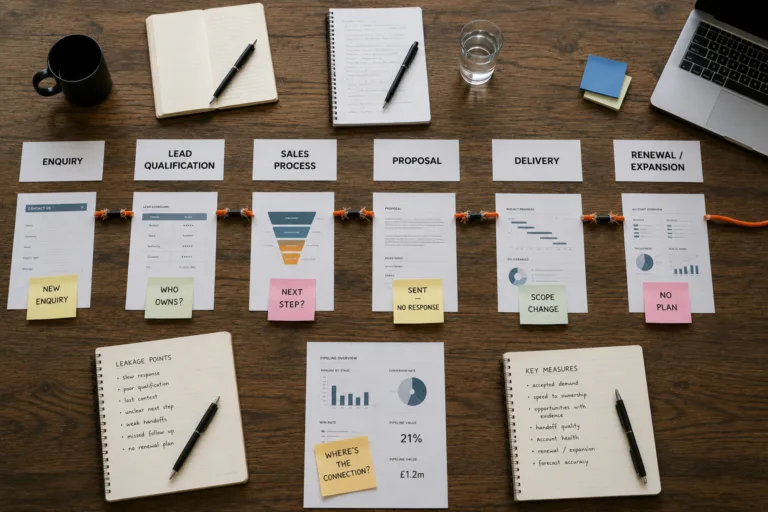
For founder-led and MD-led B2B companies, a long sales cycle is rarely just a sales problem. It is usually a commercial system problem. The website attracts interest, marketing shapes expectations, sales qualifies and progresses the opportunity, CRM records the truth, pricing frames value, proposals create commitment, operations prove deliverability, and customer outcomes create trust. When those parts do not work together, buyers slow down.
That is why b10 treats sales cycle optimisation as part of commercial transformation. The goal is not to close every deal faster. The goal is to shorten the path for the right buyers, disqualify poor-fit opportunities earlier, improve revenue efficiency and create scalable commercial control from first click to recurring revenue.
What does it mean when your sales cycle is too long?
Your sales cycle is too long when deals are not taking time because the buyer genuinely needs time. They are taking time because the commercial process is creating drag. There is a major difference between a naturally complex deal and a badly managed deal.
A complex B2B deal may require several decision-makers, technical review, budget approval, procurement, legal review and implementation planning. That is normal. A weak commercial system adds unnecessary delay on top: vague discovery, no clear next step, weak business case, late pricing conversations, inconsistent follow-up, proposal rework, CRM confusion, or uncertainty over who needs to approve what.
The commercial question is not “how do we make every buyer decide faster?” The better question is: “where are we creating avoidable delay for buyers who already have a real problem, a credible need and a reason to act?”
Why long sales cycles are more dangerous than they look
The real causes of a long B2B sales cycle
Weak ICP discipline.
Strong ICP discipline shortens the cycle because the business knows who should progress, who needs nurture, who should be disqualified and who deserves senior attention.
Positioning that does not create urgency.
Unclear positioning creates internal buyer friction. The champion may like the offer, but they cannot explain it clearly to the MD, finance lead, operations lead or technical reviewer. When the value story breaks inside the buying group, the sales cycle stretches.
Website and content that do not pre-educate buyers.
When the website does not educate, the sales team has to repeat basic explanation on every call. That extends discovery, slows qualification and pushes objections later into the process.
Poor lead qualification.
A long sales cycle often means the opportunity was allowed to enter the pipeline before there was enough evidence to treat it as a real opportunity. This creates inflated pipeline, weak forecasts and constant chasing.
CRM stages that do not match how the business actually sells.
A CRM should not be a passive database. It should be commercial infrastructure. It should show stage criteria, deal age, next action, stakeholder map, qualification evidence, proposal status, decision process and risk signals.
Weak follow-up discipline.
Follow-up should not rely entirely on memory. CRM tasks, reminders, templates, sequences and escalation rules should support the process. However, automation should not be used to hide weak sales judgement. The rule is simple: automate the predictable admin, not the relationship.
Stakeholder confusion.
In 2025, Gartner reported that 74% of B2B buyer teams demonstrated unhealthy conflict during the decision process.
Proposal friction.
Proposal speed matters, but proposal clarity matters more. A fast weak proposal still creates delay.
Pricing uncertainty.
Delivery uncertainty.
If sales and operations are disconnected, this uncertainty appears late and damages momentum. Commercial operations should support sales with clear delivery pathways, onboarding expectations, implementation plans and proof of capability.
Long sales cycle vs healthy buying process
| Scenario | What it means | What to do |
|---|---|---|
| Complex deal with multiple stakeholders | Normal B2B complexity. | Map stakeholders, support consensus and provide role-specific evidence. |
| Buyer keeps asking basic questions | Website, content or discovery is not doing enough education. | Improve pre-sales content, FAQs, proof and discovery structure. |
| Deals sit in proposal stage | Proposal, pricing, proof or decision process is weak. | Add proposal criteria, decision mapping and follow-up rules. |
| Close dates keep moving | CRM stages are not evidence-based. | Define stage exit criteria and deal risk signals. |
| Founder must rescue deals | Sales process and commercial authority are underdeveloped. | Codify qualification, messaging, pricing and escalation rules. |
| Many late-stage deals go nowhere | Qualification is too loose. | Strengthen fit, urgency, impact and decision-process criteria. |
How to shorten your sales cycle without forcing bad deals.
Step 1: Measure the real cycle.
Useful questions include:
Step 2: Define what a qualified opportunity actually means.
A strong qualification model should include:
Step 3: rebuild CRM stages around buyer progression.
Each stage should have entry criteria, exit criteria, required fields, next-step rules and risk flags. This turns CRM from admin into deal control.
Step 4: make follow-up non-negotiable.
Follow-up should be supported by CRM tasks, templates and automation. However, the message must still be commercially relevant. A generic “just checking in” email does not create urgency. A useful follow-up should move the buyer forward: clarify risk, summarise value, answer an objection, confirm a decision route or provide proof.
Step 5: create buyer enablement assets.
Useful assets include:
Forrester reported that 86% of B2B purchases stall during the buying process and that 81% of buyers express dissatisfaction with chosen providers.
Step 6: bring pricing into the conversation earlier.
Pricing clarity shortens the sales cycle because it forces honest commercial alignment earlier.
Step 7: standardise proposals without making them generic.
The proposal should confirm the commercial logic already discussed. If the proposal has to do the whole sale on its own, the earlier process was weak.
Step 8: connect sales to operations before commitment.
For complex services, technical B2B, consulting and implementation work, create a clear delivery-readiness check before the proposal goes final. This protects revenue quality and reduces late-stage rework.
Step 9: automate the right parts.
Do not automate a broken process. That only makes the wrong behaviour happen faster.
Step 10: review lost, stalled and slow deals monthly.
This turns sales cycle optimisation from a one-off project into a commercial operating habit.
A practical diagnostic checklist.
| Diagnostic question | Commercial meaning |
|---|---|
| Do we know which lead sources produce faster good-fit customers? | Tests demand quality and attribution. |
| Can we define a qualified opportunity in one sentence? | Tests qualification discipline. |
| Does every pipeline stage have clear exit criteria? | Tests CRM and sales process maturity. |
| Do all active deals have a next step and date? | Tests follow-up control. |
| Can a buyer explain our value internally without us in the room? | Tests positioning and buyer enablement. |
| Do proposals confirm a decision or reopen the sale? | Tests discovery, pricing and proposal quality. |
| Do we involve operations before complex commitments? | Tests revenue quality and delivery readiness. |
| Do we analyse customer quality after deals close? | Tests whether faster sales create retained value. |
How b10 helps shorten sales cycles.
That can include ICP clarity, positioning, website journey, lead capture, CRM structure, qualification, pipeline stages, sales follow-up, proposal workflow, pricing logic, operational handoff, automation and reporting. The work is practical. The outcome is a commercial system that gives buyers more clarity, gives sales teams more control and gives leadership better visibility.
Through CTI, b10 can assess commercial maturity across the wider system and identify where sales cycle drag is actually coming from. Through implementation and managed commercial operations, b10 can help rebuild the parts that need fixed: CRM, pipeline, sales process, content, automation, dashboards and handoff workflows.
Final thought.
The fix is not pressure. The fix is commercial control.
Shorten the sales cycle by making the buyer path clearer, qualification sharper, CRM more truthful, follow-up more consistent, proposals more decisive, pricing more transparent and delivery more credible. That is how B2B companies improve sales velocity without sacrificing revenue quality.
Let’s shorten your sales cycle.






Shorten Sales Cycle FAQs.
Your sales cycle is too long because good-fit buyers are probably facing unnecessary friction. Common causes include weak qualification, unclear value, slow follow-up, messy CRM stages, poor stakeholder alignment, late pricing and proposal delays.
You shorten a B2B sales cycle by improving qualification, defining buyer-stage criteria, tightening CRM discipline, speeding up follow-up, supporting stakeholder consensus and giving buyers clearer proof, pricing and next steps.
No. Complex B2B deals may naturally take longer because of risk, procurement, stakeholders and implementation detail. The problem is avoidable delay caused by weak commercial process.
CRM can reduce sales cycle length when it reflects the real sales process and supports stage criteria, next steps, follow-up, stakeholder tracking, proposal visibility and reporting. CRM alone will not fix an undefined process.
Track median cycle length, stage duration, deal age, source-to-close time, proposal-to-close rate, close date movement, follow-up compliance, stalled deals, lost reasons and customer quality after win.
Deals often stall after proposal because the proposal does not match the buyer’s decision process, pricing was introduced too late, stakeholders are not aligned, proof is weak, or the next step was not clearly agreed.
Qualification affects sales cycle length because poor-fit prospects consume time without a realistic path to commitment. Strong qualification focuses sales effort on buyers with fit, urgency, authority, value and decision clarity.
You should automate predictable follow-up tasks, reminders and alerts, but not relationship judgement. Automation should support timely, relevant communication, not replace commercial thinking.
Positioning affects the sales cycle because buyers move faster when they understand what you do, why it matters, what problem you solve, how you are different and why they should act now.
The best first step is a sales cycle diagnostic. Review CRM data, stage duration, qualification criteria, follow-up discipline, proposal process, stakeholder mapping and lost or stalled deals before changing tools or tactics.
Ready to transform your sales?