



The appointment is evidence of a wider shift:
organisations are moving beyond isolated software implementations and investing in connected operational systems that improve customer experience, visibility and efficiency.
Why organisations are investing in operational workflow transformation.
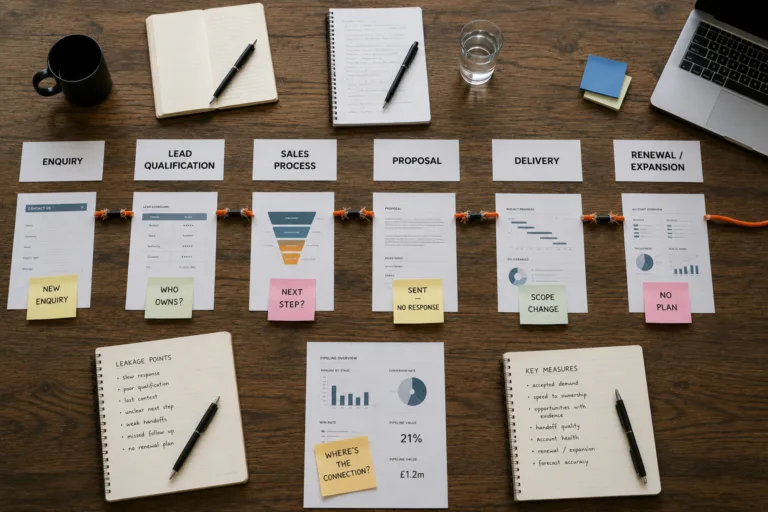
This is different from introducing a new software platform. A platform can improve one function while leaving the wider operating model fragmented. Operational workflow transformation looks across the complete flow: what starts the process, which information is required, where decisions happen, who owns each stage, how systems exchange data, how exceptions are handled and how customers are kept informed.
That broader view has become commercially important because organisations are operating under two simultaneous pressures. Customers expect faster, clearer and more consistent experiences. At the same time, leaders need to improve productivity, control costs and scale without allowing administrative work to grow at the same rate as demand.
Disconnected processes make those objectives harder to reconcile. Connected operations make them mutually reinforcing.
Disconnected systems create operational friction.
A customer submits information through one channel. A member of staff re-enters it into another system. An approval is requested by email. A spreadsheet tracks progress. A separate platform is used to complete the work. Someone must then remember to update the customer and reconcile the records.
Each tool may perform its own function adequately. The problem exists between them.
That is why adding software does not necessarily improve operational efficiency. An organisation can have a strong CRM, capable service software and multiple automation tools while still relying on manual coordination. If data, decisions and status do not move reliably between those systems, employees become the integration layer.
Manual hand-offs increase delay and risk.
Each hand-off also creates another point where information can be omitted, duplicated or misunderstood. As volume increases, these small risks compound.
Duplicate records weaken operational visibility.
Leaders may have plenty of data but little confidence in it. Reporting then depends on manual reconciliation, and management decisions are made from a delayed or incomplete view of the operation.
Informal workarounds become permanent processes.
These practices can keep an operation moving, but they create dependency on individual knowledge. The process becomes difficult to govern, difficult to transfer and vulnerable when experienced employees are unavailable.
Administrative effort grows faster than value.
The organisation becomes busier, but not proportionately more productive. Headcount is added to administer the process rather than improve the customer outcome. Revenue may increase while revenue efficiency deteriorates.
Where is operational friction constraining growth?
Customer experience is shaped by operational design.
A prompt confirmation depends on a process recognising that an event has occurred. An accurate update depends on a reliable operational record. A consistent commitment depends on ownership, capacity and status being visible. A smooth multi-location experience depends on common operating rules and controlled local variation.
Customer experience is therefore the external expression of operational design.
When workflows are disconnected, customers feel the effects. They repeat information, wait for updates, receive inconsistent messages or encounter different processes depending on the channel, team or location involved. The visible issue appears to be communication. The underlying cause is often fragmented business operations.
Employees feel the same fragmentation from the other side. They search for information, monitor inboxes, chase colleagues and manually explain delays. This effort is rarely captured as a distinct operational cost, but it consumes capacity every day.
Operational workflow transformation connects these two perspectives. It improves customer experience by improving the operational experience required to deliver it. The objective is not to remove people indiscriminately. It is to remove repetitive administration and give people the information, context and control required to make better decisions.
Operational orchestration goes beyond workflow automation.
Operational orchestration coordinates the complete sequence. It keeps systems, data, responsibilities, decisions and communications aligned from the initial trigger to the intended outcome.
A connected operational workflow normally includes:
The strongest workflow automation consultancy should therefore begin with operational diagnosis and process design, not a predetermined technology. The question is not simply:
“What can be automated?”
“How should this operation work, and where can connected technology make that model more reliable?”
The commercial value of connected operational systems.
Reduced administrative effort.
Faster end-to-end cycle times.
More consistent customer outcomes.
Stronger operational control.
Better management information.
Scalability without proportional complexity.
The commercial question is therefore broader than the cost of implementing automation. Leaders should compare that investment with the continuing cost of delay, rework, poor visibility, inconsistent customer experience and additional coordination as the organisation grows.
Why isolated software implementations underperform.
Implementations underperform when organisations begin with a product and work backwards. Existing processes are digitised without being challenged. One team gains efficiency while another inherits additional work. Applications are integrated before data ownership is agreed. The ideal customer journey is configured while frequent exceptions remain outside the system.
The result may be a technically successful implementation that delivers limited commercial improvement.
Operational workflow transformation starts from a different question:
What must happen, in what order, with what information and ownership, to deliver the intended customer and commercial outcome?
Where is operational friction constraining growth?
Why operational workflow transformation is accelerating.
Customer expectations expose internal fragmentation.
Internal system boundaries are irrelevant to them. A delay caused by a hand-off between departments is still experienced as a delay from one organisation.
Productivity pressure is shifting attention to flow.
Operational efficiency consulting is consequently moving beyond local cost reduction. The larger opportunity is to improve how value flows through the whole operation.
Technology has become easier to connect.
The differentiator is no longer access to automation alone. It is the ability to apply it to a well-designed operating model.
Growth makes informal processes unsustainable.
That model becomes less reliable as the organisation grows. More customers, employees, services or locations create more hand-offs and more possible points of failure. Connected systems convert implicit knowledge into a repeatable operational capability.
Leaders need visibility before problems reach the customer.
This allows leaders to intervene earlier and improve the process using operational evidence rather than anecdote.
How to determine whether transformation is required.
Common indicators include:
A practical approach to operational workflow transformation.
Define the intended customer and commercial outcome.
Map the real workflow across teams and systems.
Identify friction and failure demand.
Establish data ownership and operational states.
Separate predictable rules from judgement.
Design exception paths deliberately.
Measure flow and outcomes.
Improve the system after implementation.
Where is operational friction constraining growth?
What this project indicates about the market.
The client will remain confidential, and no implementation outcomes will be claimed before the project has been completed. We look forward to sharing more about the implementation and the operational outcomes once the project has been delivered.
The important signal is the nature of the investment. Organisations are moving beyond software acquisition as the objective. They are investing in the connected operational capability required to make customer journeys, internal work and management information function as one system.
This project reflects a broader trend we’re seeing across commercial organisations: investment is moving beyond isolated software implementations towards connected operational systems that improve customer experience while reducing administrative effort.
Frequently asked questions.
Operational workflow transformation is the redesign and connection of the people, processes, data, decisions and systems that move work through an organisation. It aims to improve the complete operational and customer journey, rather than automate isolated tasks.
Workflow automation performs specific actions automatically. Operational workflow transformation first redesigns the wider process, including ownership, data, decisions, exceptions and measures, then applies automation where it improves the complete flow.
Operational orchestration coordinates the sequence of systems, data, people, rules and communications from an initial event to an intended outcome. It ensures that individual automated actions operate as part of one controlled workflow.
Disconnected systems require employees to copy information, reconcile records, chase approvals, monitor status and correct errors. This administrative effort grows with volume and reduces the capacity available for customer service and higher-value work.
Connected systems allow customer communications and service actions to be triggered by reliable operational events. This can reduce delays, repeated requests for information and inconsistent updates across teams, channels or locations.
No. Systems integration enables applications to exchange data. Operational transformation redesigns how the organisation works. Integration supports transformation, but connecting systems without clear processes, ownership and data rules can preserve or increase operational problems.
Processes are strong candidates when they are frequent, rules-based, dependent on repeated data transfer or vulnerable to delay and error. Processes involving significant ambiguity, risk or relationship judgement should retain appropriate human control.
Measures should reflect business outcomes, including cycle time, waiting, rework, exception volume, administrative effort, customer effort, service consistency and operational visibility. The number of automations deployed is not a sufficient success measure.
External support is useful when a workflow spans several teams, systems or locations; when internal ownership is fragmented; or when the organisation needs independent process design, systems integration and governance expertise alongside implementation capability.
Operational workflow transformation is a component of commercial transformation. It connects the systems and processes that convert demand into delivery, customer value and recurring revenue, helping the organisation improve efficiency and commercial performance together.
Book a commercial diagnostic.